Film creation successfully initiates cultural cooperation and deepens the bilateral “Pauk-Phaw” friendship.
MYANMAR consistently and firmly upholds the “One China Policy” as a fundamental principle in the field of international relations, said President of the Republic of the Union of Myanmar U Min Aung Hlaing at the opening of the 2026 China Film Week to mark the 76th anniversary of diplomatic relations between China and Myanmar at the J Cineplex of the Ottarathiri Departmental Store in Nay Pyi Taw yesterday afternoon.
Speaking on the occasion, the President reaffirmed that to further strengthen the bilateral partnership and contribute to regional peace and stability, Myanmar will continue to adhere to the “One China Policy” and will work closely with China to deepen cooperation across various sectors for the common interests of the peoples of both countries.
He continued that following the major earthquake in Mandalay, China, as a close friend, China provided Myanmar with emergency humanitarian assistance valued at 1.1 billion yuan to support recovery and rehabilitation efforts. As this was the first foreign assistance received during a time of greatest difficulty, China’s timely support has greatly strengthened both the Government and the people affected by the disaster.
The People’s Republic of China has been continuously providing assistance to Myanmar in key social development sectors such as education, health, social affairs, and rural development, among others.
On the occasion of the 76th anniversary of diplomatic relations between the two countries, the President stated that continued efforts will be made to promote sustainable mutual interests for the peoples of both nations, regional peace and stable development, the building of a Myanmar-China community with a shared future, and the acceleration of development momentum.
Film artistic creation helps initiate cultural cooperation successfully and further cements the “Pauk-Phaw” friendship between the two countries.
In terms of bilateral cooperation in the film sector, the President unveiled that with the assistance of the Embassy of China to Myanmar, classic Myanmar heritage films, including the old Myanmar film “Nga Ba”, have been successfully preserved for long-term use. These films have been converted from film format into Digital Cinema Package (DCP) format using digital technology, which has already been received.
Television drama series from both countries are also being translated into each other’s languages and broadcast reciprocally.
The Chinese films and television drama series are expected that the shared emotional experiences of audiences in both countries will foster genuine bonds, mutual understanding, and closer friendship.
Chinese Ambassador to Myanmar Ms Ma Jia said that although Myanmar and China have different social systems, Myanmar was the first country to recognize New China. China has also consistently supported Myanmar’s national peace, reconciliation, and stability.
The Five Principles of Peaceful Coexistence, jointly proposed by China and Myanmar, have become a fundamental norm governing international relations.
Extensive cooperation and exchanges have been carried out in the film sector between the two countries, playing an active role in enhancing mutual understanding and friendship between the peoples of the two nations.
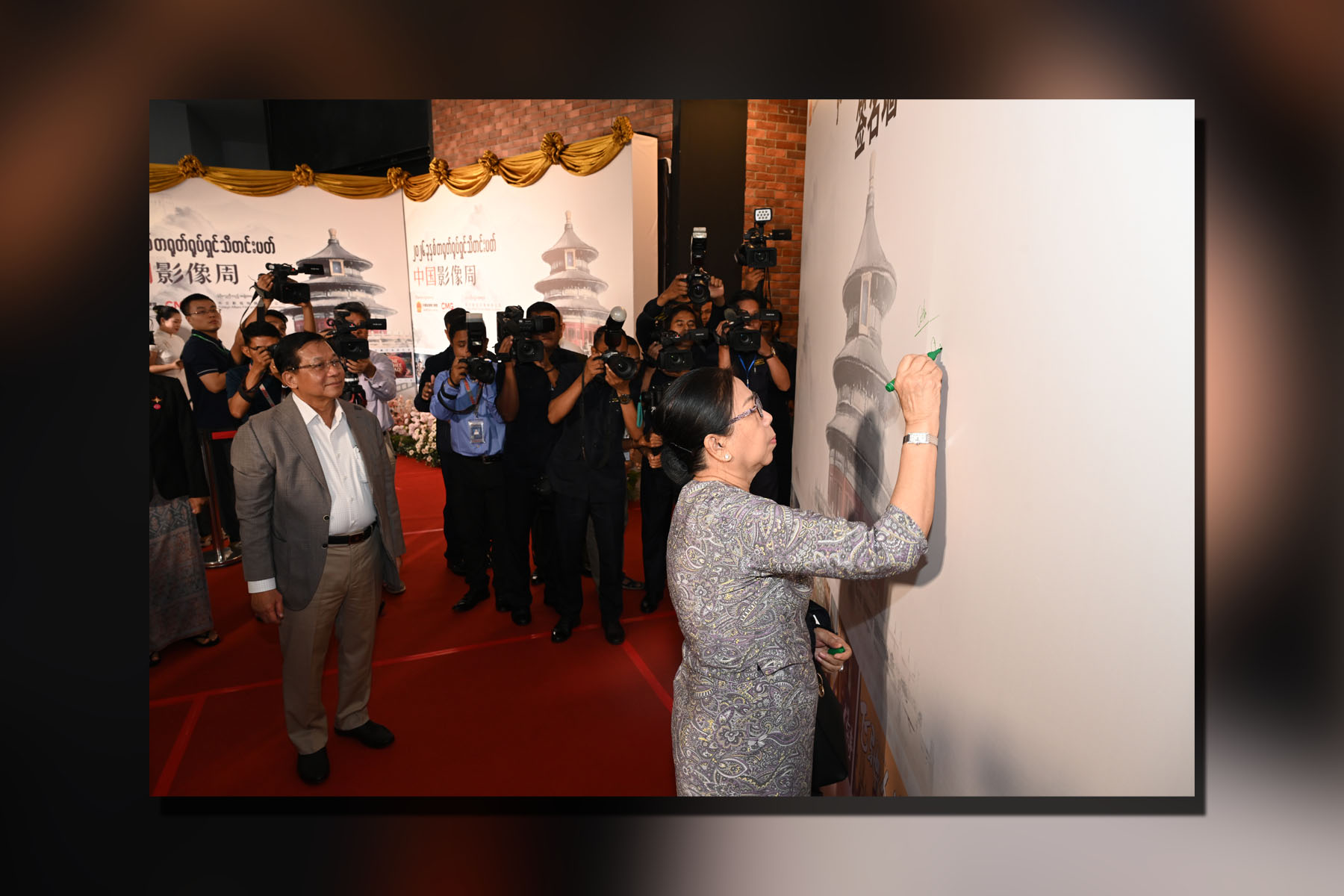
At the ceremony, the President and his wife, and the Chinese Ambassador to Myanmar put on their commemorative signatures.
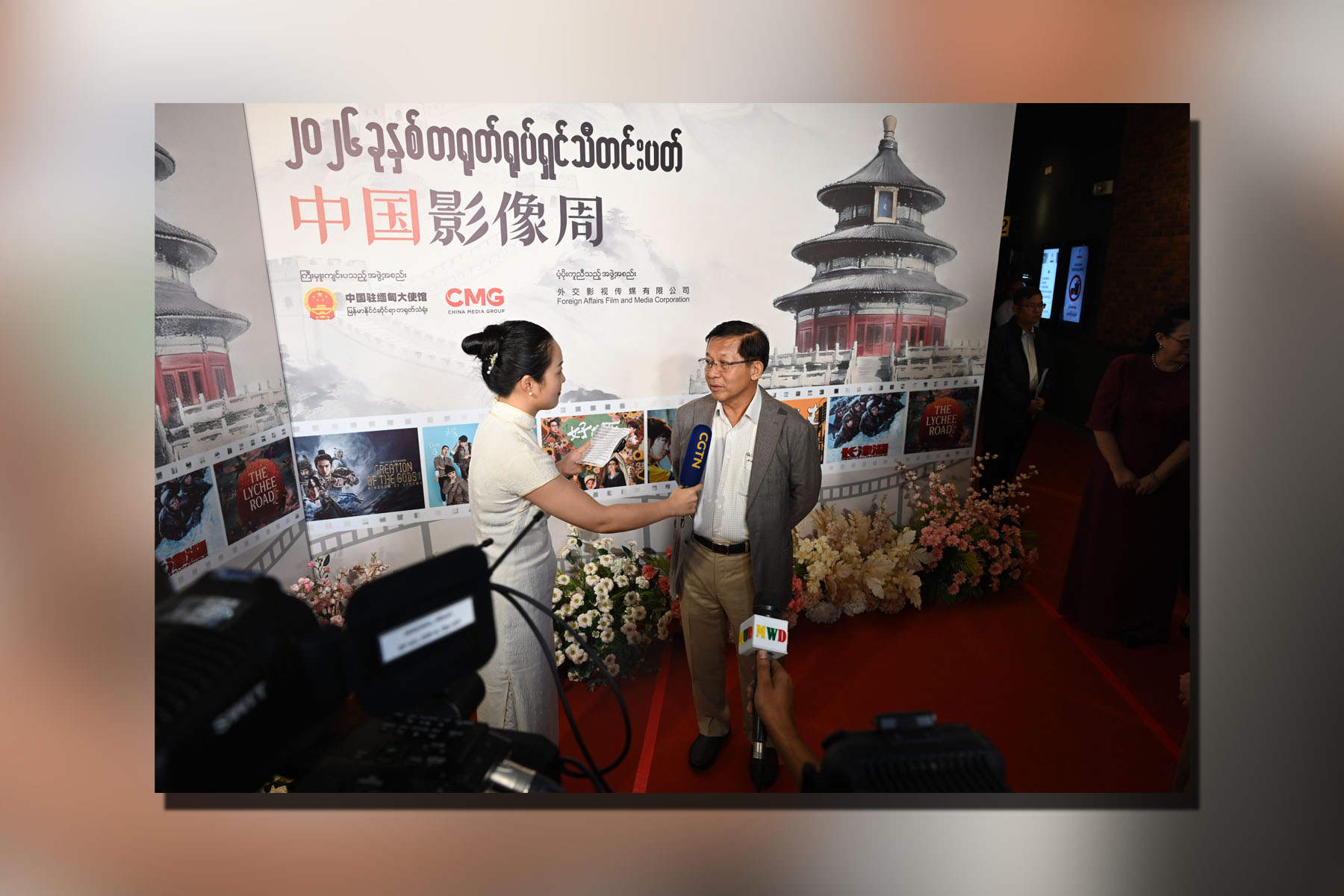
The President responded to the questions raised by reporter Ms Zhang Xiaoning from China Media Group (CMG). The full text of the answers of the President is as follows:
In connection with the Global Civilization Initiative adopted by President Xi Jinping, film festivals of this kind are held in Myanmar. This helps to foster closer familiarity between the Myanmar people and China’s culture, arts, and aesthetic traditions. Furthermore, film encompasses the full range of filmmaking techniques as well as acting skills. By watching films produced in China, one can better appreciate Chinese cinematic craftsmanship and acting performances. This, in turn, can help further enhance cooperation between Myanmar and China in the fields of film and the fine arts. It can also significantly contribute to strengthening the “Pauk-Phaw” (fraternal) friendship between the two countries.
The BRI is a globally supportive initiative. Within it, there is a China-Myanmar Economic Corridor, which is also a component that emerged from the BRI. These frameworks provide significant support when implemented through cooperation, and there are already tangible benefits being experienced.
In addition, it greatly contributes to the previously mentioned “Pauk-Phaw” (fraternal) relations. Furthermore, there are many areas of collaboration in trade and investment, science and technology, tourism, and various other fields — there is still a great deal to be done. These are areas that will bring significant benefits to our country.
Therefore, we would also like to express our desire to further expand cooperation in all these sectors. As I mentioned earlier, although diplomatic relations span 76 years, the relations between the two countries actually date back hundreds and even thousands of years. That is why this relationship is referred to as the “Pauk-Phaw” (fraternal) relationship.
In 2011, the relationship was upgraded to a Comprehensive Strategic Cooperative Partnership. Later, following President Xi Jinping’s 2020 visit, an agreement was reached to further build a “community with a shared future, sharing weal and woe”.
President U Min Aung Hlaing, his wife Daw Kyu Kyu Hla, and attendees at the ceremony saluted the flag of the Republic of the Union of Myanmar and then enjoyed a video clip on the 2026 Chinese Film Week and a film ‘Lighting Up the Stars’.
After the ceremony, the President cordially greeted the Chinese Ambassador and attendees.
Also present at the ceremony were Vice-President Nan Ni Ni Aye, Speaker of the Pyithu Hluttaw U Khin Yi and his wife, Amyotha Hluttaw Speaker U Aung Lin Dwe and his wife, Commander-in-Chief of Defence Services General Ye Win Oo and his wife, Union ministers and their wives, the Nay Pyi Taw Council Chairman, senior Tatmadaw officers from the Office of the Commander-in-Chief and deputy ministers in addition to media personnel and officials. — MNA/TTA