
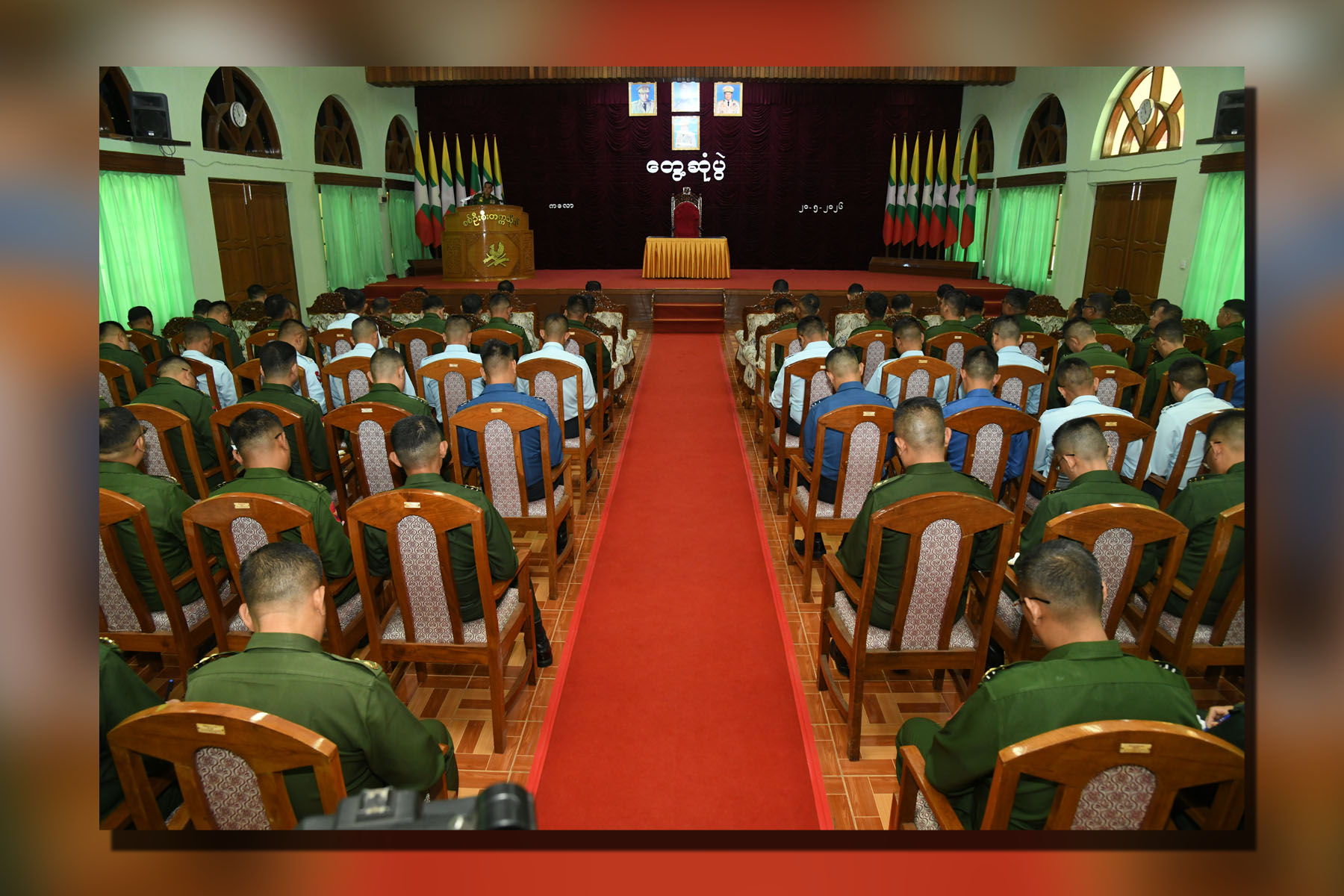
COMMANDERS and senior officers need to maintain close contact with military families and engage positively with the public, said Commander-in-Chief of Defence Services General Ye Win Oo at the meeting with senior officer instructors and senior officer trainees at the local training school in Kalaw yesterday morning.
Speaking on the occasion, the General said that commanders and senior officers have to conduct ceremonies for Tatmadaw members to express their wishes, discuss, and hold entertainment events with their military families properly and correctly.
He stressed that commanders need to ensure that Tatmadaw members under their command do not engage in actions towards the public that could lead to misunderstandings or negative perceptions among the people. In dealing and interacting with the public, emphasis should be placed on adhering to the prescribed rules of conduct, prohibitions, and the ten codes of conduct to be observed towards the public.
Regarding administration, the General noted that commanders are vested with judicial authority and therefore need to carry out military judicial matters with proper judgement and sound reasoning.
By conducting administrative measures, he continued that by carrying out the general staff, adjutant and quartermaster measures through check, recheck, and counter-check procedures, the operational weaknesses can be avoided, and the capabilities of military units will be enhanced.
The General highlighted that military capability means an armed force with combat capability and combat power, and commanders need to continuously train their units in order to achieve such combat capability. To strengthen military capability, individual personnel must be highly capable, weapon proficiency must be ensured, and troops must be fully trained, in addition to being able to correctly apply military tactics and strategies.
He underlined that if administrative capability declines, military capability and organizational capability will also decline, and if discipline is lacking, organizational effectiveness may also deteriorate. Therefore, leaders need to closely supervise compliance with military discipline and management practices, which are integral parts of administrative capability.
The General gave a guideline that to become good leaders, one must have the ability to exercise self-control and be able to make farsighted decisions with broad-mindedness. A leader must also constantly look after subordinates, guiding, correcting, and advising them as necessary.
After the meeting, the General commended and warmly greeted two senior officer trainees who had been promoted by one step in rank for outstanding operational performance in courageously carrying out national defence and security duties on the front lines, and who had subsequently been granted the opportunity to attend the training course.
Also, present at the meeting were Commander-in-Chief (Navy) Admiral Htein Win, Commander-in-Chief (Air) Lt-Gen Tun Win, senior Tatmadaw officers from the Office of the Commander-in-Chief, the commander of the Eastern Command, senior officer instructors from the Command and General Staff College and senior officer trainees.
The General had lunch together with senior officer instructors and senior officer trainees at the trainee mess hall. — MNA/ TTA