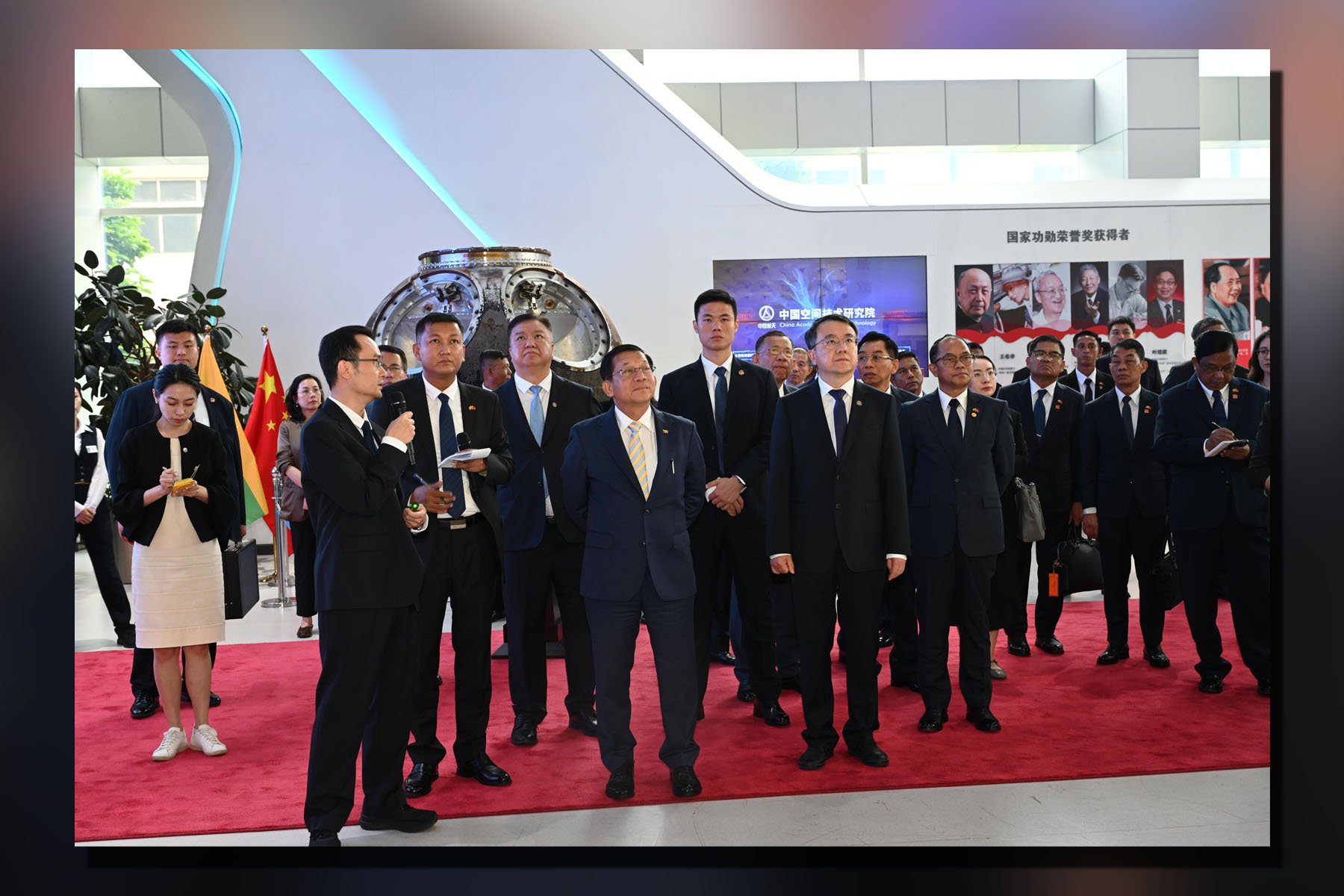
THE high-level Myanmar delegation led by President of the Republic of the Union of Myanmar U Min Aung Hlaing visited Aerospace City yesterday afternoon.
The President is currently in Beijing of the People’s Republic of China at the invitation of the Chinese President.
The President and party were warmly welcomed by the Chief Executive of Aerospace City at the China Aerospace Science and Technology Corporation (CASC).
At the hall, the Chief Executive extended greetings and presented facts about the Aerospace City. A video clip on the city was screen.
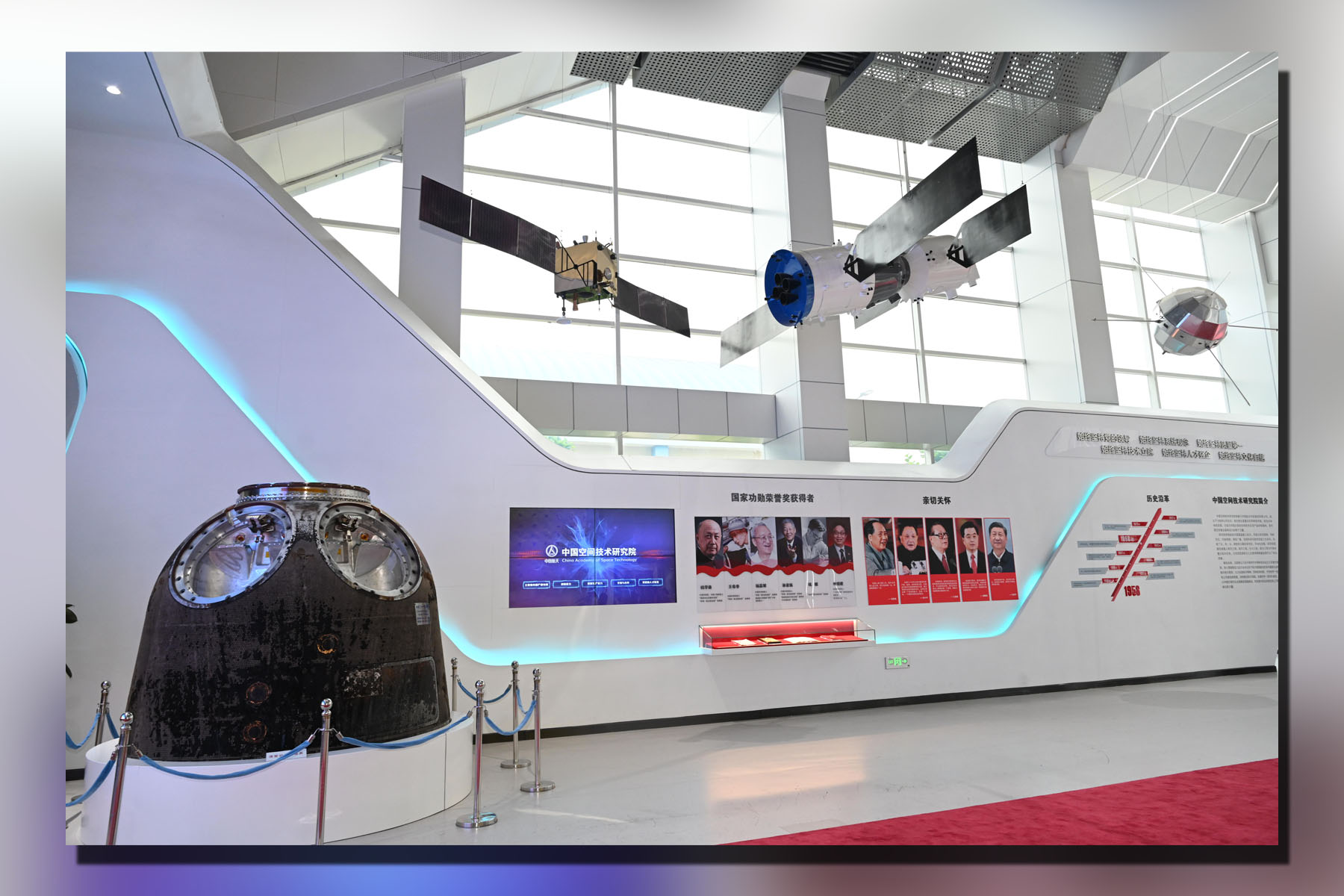
The President and party visited the exhibition hall where they observed the booths on the history of the city, the Baidu Navigation System, the telecommunication system, the Earth Remote Sensing (ERS), and the training system for astronauts. The Chief Executive and officials explained the launch of spacecraft by China and the successful landing on Earth, the construction of the space station, successful lunar landings, the transport of cargo and materials, the capabilities of spacecraft, and related historical data.
Aerospace City is located in the northwestern part of Haidian District in Beijing. It is often referred to as “Project 921” and serves as a base for astronaut training and a mission control centre. The facility is a large campus covering an area of 2.3 square kilometres (577 acres) northwest of Beijing. It began operations in 1998 and is the base for the Beijing Aerospace Control Centre (BACC), the China Academy of Space Technology (CAST), and the Astronaut Centre of China (ACC).
The China Aerospace Science and Technology Corporation (CASC) within Aerospace City is a state-owned high-technology enterprise directly supervised by the central government of China. It is primarily responsible for implementing China’s space programmes and carrying out the country’s defence and space exploration activities. By integrating numerous world-class enterprises in the aerospace systems sector, it conducts research, design, manufacturing, testing, and satellite launch operations. As a space transport system, is responsible for the design and production of the Changzheng long-range rocket launch vehicles, which form the main pillar of China’s spaceflight programme.
It also conducts manned spaceflight and exploration missions in addition to building the Tiangong space station. It has carried out the Chang’e lunar exploration programme and the Tianwen Mars exploration missions. It has also developed and managed satellite systems, including the BeiDou satellite orbit system, as well as the production of Gaofen Earth observation satellites and communication satellites. In terms of the application of space technology, emphasis is being placed on the broad utilization of technology across civilian sectors, including information technology, new energy, advanced manufacturing, and the production of environmental protection support equipment.
It is also reported that efforts are being made to apply space technologies widely across civil sectors. In addition, it transfers space technology to Myanmar, manages the admission and training of scholarship students in the field of space science and technology, and uses satellite technology to improve the collection of necessary forest, climate, water resource, and geographical data for the development of the agriculture and livestock sectors.
In response to the clarification, the President asked about he wanted to know and observed the manned spaceflight of China.
The President and party cordially greeted the Chief Executive of the Aerospace City and left for the Diaoyutai State Guesthouse. — MNA/TTA