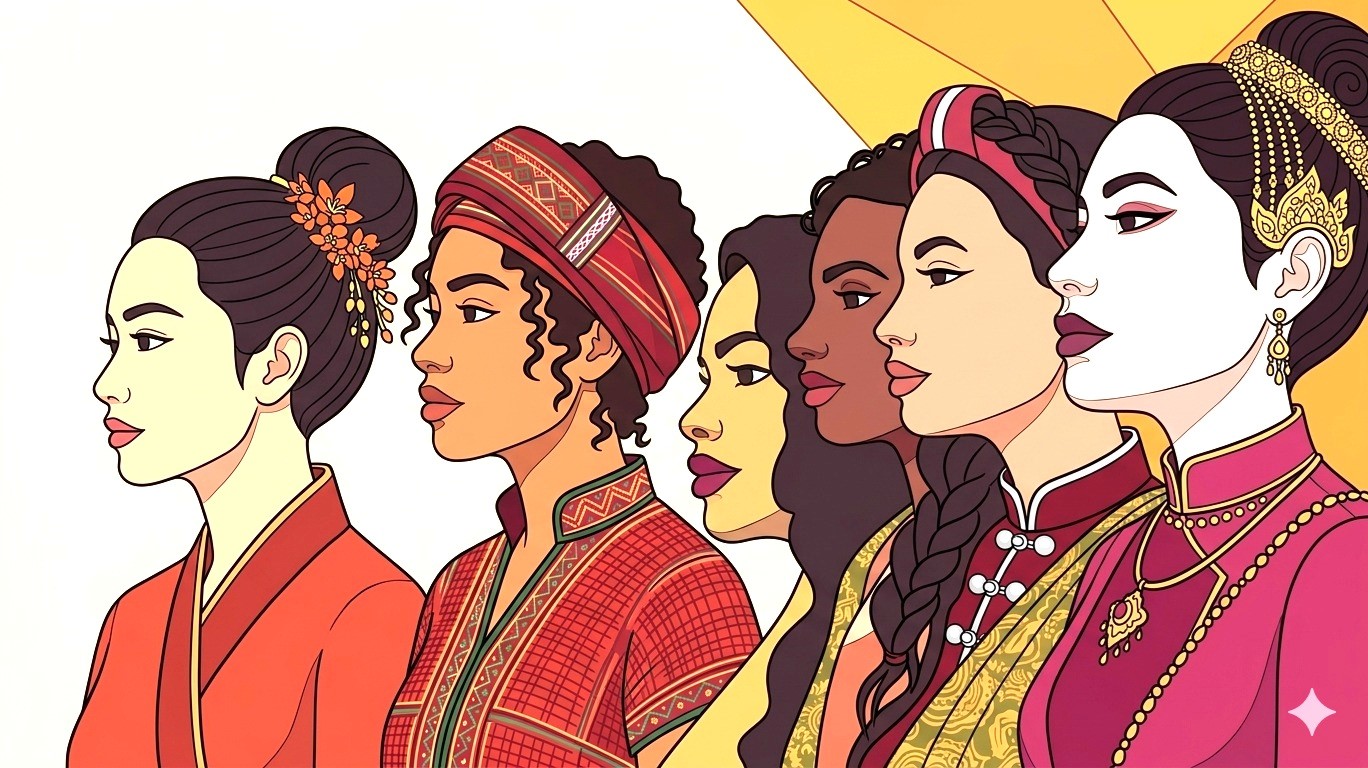
As international momentum builds for gender equality, Myanmar’s women are meeting the moment with institutional resolve, measurable progress, and deep cultural resilience.
By Dr Aung Tun
1. Introduction
Every 3 July, Myanmar marks Myanmar Women’s Day – a national observance distinct from, though complementary to, International Women’s Day on 8 March. While the world’s day looks outward to global solidarity, Myanmar’s own day looks inward: a moment to take stock of how far the nation’s women have come, and how much further the journey towards genuine equality still has to go. This year’s observance arrives at a particularly significant moment, with Myanmar taking one of its most consequential institutional steps for women in decades. This article looks at the origins of Myanmar Women’s Day, the foundations built over thirty years, and the milestone of the past year that makes this 3 July especially meaningful.
2. A World Converging on Women’s Rights
In late April 2026, over 6,500 gender equality advocates from 180 countries gathered in Naarm (Melbourne), Australia, for the Women Deliver 2026 Conference (WD2026) – the most significant global convening on women’s health and rights in years. Held under the theme “Rights. Justice. Action. For ALL Women and Girls,” it concluded with the Melbourne Declaration for Gender Equality: a collective demand for systemic change, moving from tokenistic representation to meaningful, institutionalized leadership, backed by transparent accountability and ring-fenced budgets. For Myanmar, these demands do not arrive as abstract foreign ideals – they map precisely onto structures the country has been building for decades.
3. Myanmar Women: A Legacy of Strength and Resilience
Myanmar’s women carry a tradition of courage that stretches far beyond modern policy frameworks. Constituting approximately 52 per cent of the national population, they are the majority voice of a country that has, across generations, drawn strength from their courage, intellect, and resilience – and their participation in political, economic, social, and community affairs is not simply desirable, but essential. From the legendary loyalty of Amara, Kinnari, Maddi, and Thambula in classical literature to the pioneering achievements of real historical figures, Myanmar women have always been forces of transformation.
The historical record affirms this. Across successive eras, Myanmar women broke ground in social welfare, law, medicine, scholarship, the military, arts, and public service – earning distinctions that placed them among the most remarkable figures of their time. Their achievements were not isolated acts of individual brilliance but expressions of a culture that, even amid the constraints of each era, produced women capable of leading, innovating, and inspiring. This tradition did not end with any single generation. Today, women continue to excel across science and technology, public administration, business, and civil society – a continuity of capability that stretches from the distant past into the present.
4. Building Institutions: The National Framework for Women’s Advancement
Myanmar’s institutional commitment to gender equality has been three decades in the making. Following the Fourth World Conference on Women in Beijing in 1995, Myanmar adopted the Beijing Platform for Action (BPFA), which identified 12 priority areas, including education, health, livelihoods, and ending violence, as the framework for advancing women’s development. On 3 July 1996, Myanmar established the Myanmar National Committee for Women’s Affairs (MNCWA), and that same date was subsequently designated Myanmar Women’s Day. Since 1998, this day has been observed annually at both the union and state/region levels.
The National Strategic Plan for the Advancement of Women (NSPAW) further codified these commitments into actionable policy. The first phase (2013-2022) was implemented across government ministries, and the current phase, NSPAW 2023-2032, continues with 12 specialist sub-committees covering key sectors including education, health, livelihoods, economic empowerment, and the elimination of violence against women. Myanmar also ratified the Convention on the Elimination of All Forms of Discrimination Against Women (CEDAW) in 1997 and actively participates in the ASEAN Committee on Women (ACW) and the ASEAN Commission on the Promotion and Protection of the Rights of Women and Children (ACWC). In 2026, the establishment of a dedicated Ministry of Women’s Affairs elevated gender equality to a cabinet-level portfolio – precisely the kind of structural reform the Melbourne Declaration called for.
5. Measuring Progress: Education, Health, and Leadership
The data behind Myanmar’s gender story is compelling. In education, women constitute 63.6 per cent of higher education enrolment and 47.19 per cent of science and technology students – figures that challenge global assumptions about women’s exclusion from STEM. Girls’ matriculation pass rates reached 64.31 per cent in 2023-2024. Female literacy, which stood at 73 per cent in 2000, has risen to 85 per cent in 2023 – above the global average of 82.7 per cent and tracking closely with the ASEAN regional figure of 95.1 per cent. A literate mother, as recognized in Myanmar’s traditional wisdom, raises healthier, better-educated children and is better placed to support her family’s economic stability – breaking intergenerational cycles of poverty.
In health, a woman born in Myanmar today can expect to live 72.5 years – nearly nine years longer than a man. Infant and under-five mortality rates have declined consistently, reflecting sustained investment in maternal and child health services. In public life, women hold 60.58 per cent of civil service positions and 54.75 per cent of Deputy Director-level and above posts – figures that stand out even by global standards. In a region where parliamentary representation has only just reached a historical high of 23 per cent, Myanmar’s strong administrative representation is a real and substantial achievement.
6. The Work That Remains: Priority Areas for Action
Myanmar’s achievements are genuine – and they create a foundation, not a finish line. Three priorities stand out from the Melbourne Declaration’s roadmap. First, closing the secondary education gap: while primary completion rates for girls already exceed those of boys, retention at middle school (18.8 per cent completion) and high school (11.7 per cent) requires targeted scholarships, improved rural infrastructure, and community engagement that actively challenges customs pushing girls out of school early. Second, matching civil service strength with private sector opportunity: women’s impressive presence in government must be complemented by equal access to credit, vocational training, and market linkages in the private economy. Economic empowerment cannot stop at the civil service door.
Third, ending gender-based violence: the Department of Social Welfare operates One-Stop Women Support Centres (OSWSC) in seven cities – Yangon, Mandalay, Lashio, Mawlamyine, Loikaw, Monywa, and Sittway – and a 24-hour helpline (now reachable via the memorable number 1566, Viber, and Facebook). A draft law on the prevention of violence against women is under active review. Myanmar’s participation in the ASEAN Gender-Based Violence prevention programme and the Women, Peace, and Security (WPS) framework further strengthens this commitment. The Melbourne Declaration’s call for “budgeted, enforceable rights” provides the standard against which these plans must be measured.
7. When Women Thrive, Nations Rise
Myanmar Women’s Day exists to honour a simple but enduring truth: that the advancement of women is the advancement of the nation. From the founding of the MNCWA in 1996, to the MWAF in 2003, to the National Strategic Plan for the Advancement of Women now guiding the country through 2032, to the establishment of a dedicated Ministry of Women’s Affairs in 2026 – each milestone represents not an endpoint, but a deliberate, decades-long act of institution- building. As Myanmar marks this 3 July, the task ahead is to build on these foundations with continued urgency, accountability, and unwavering commitment – because when Myanmar’s women thrive, Myanmar itself thrives.
The old proverb “the hand that rocks the cradle rules the world” resonates differently today: it is not a metaphor for soft influence, but a recognition that when women are educated, economically active, protected from violence, and empowered to lead, entire communities – and entire nations – are transformed.
References
Women Deliver. (2026). Women Deliver 2026 Conference (WD2026), 27–30 April 2026, Naarm (Melbourne), Australia. Conference Report and Melbourne Declaration for Gender Equality. https://womendeliver. org
1. Ministry of Planning and Finance, Myanmar. (2025). Myanmar Statistical Yearbook 2025. Government of the Republic of the Union of Myanmar, Naypyitaw.
2. Ministry of Social Welfare, Relief and Resettlement, Myanmar. National Strategic Plan for the Advancement of Women (NSPAW) 2023–2032. Department of Social Welfare, Myanmar.
3. ASEAN Secretariat and UN Women. (2024, released 2025). ASEAN Gender Outlook 2024: Achieving the SDGs for All. Jakarta: ASEAN Secretariat.
4. UN Women. (2026). International Women’s Day 2026: “Rights. Justice. Action. For ALL Women and Girls.” United Nations. https://www.unwomen.org