
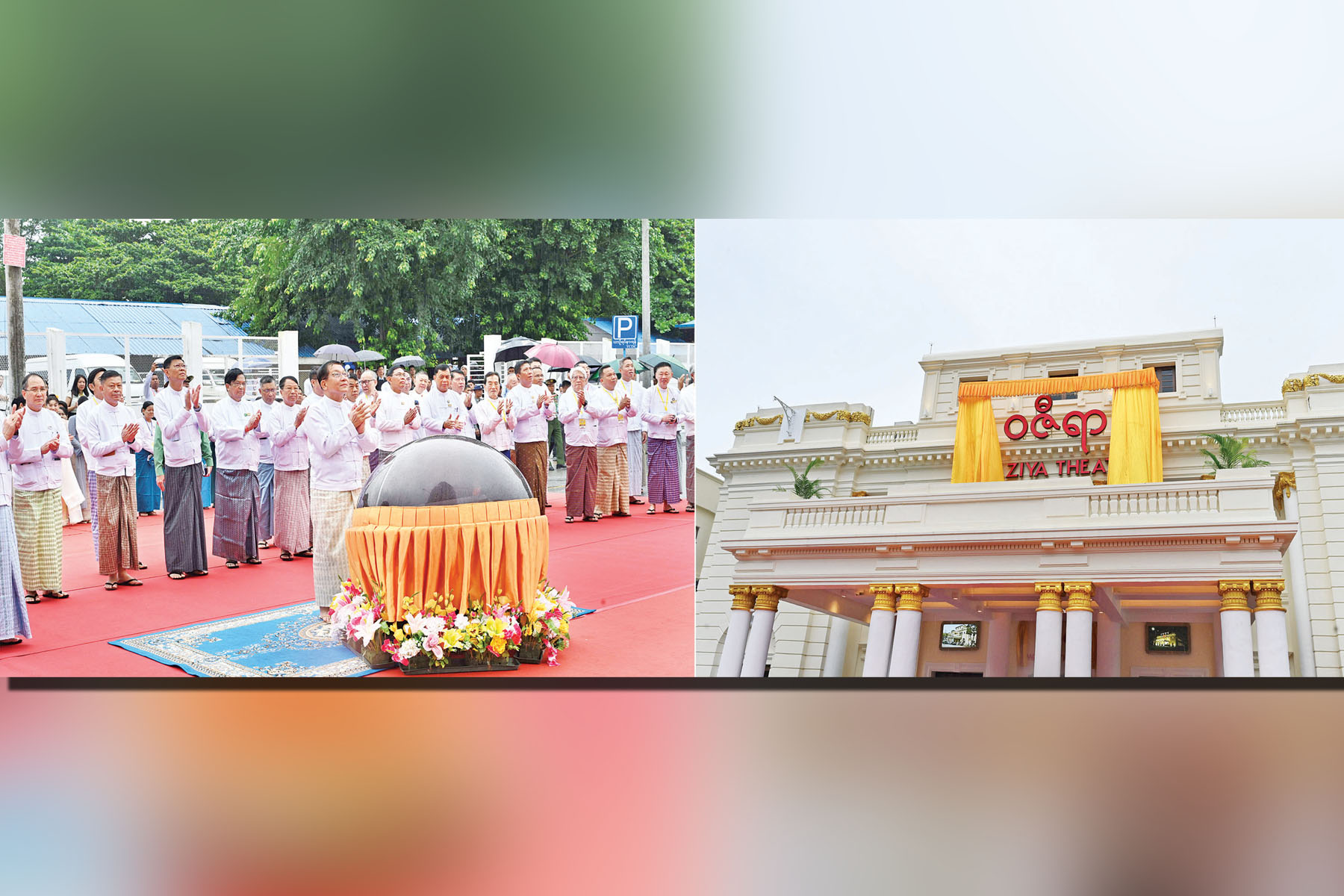
MYANMAR’S historic Wazira Cinema in Yangon has been officially reopened as an international-standard Red-Carpet Theatre following a major renovation project to preserve its cultural and architectural heritage.
The reopening ceremony of the 103-year-old landmark, located on Bogyoke Aung San Road in Kyauktada Township, was attended by President of the Republic of the Union of Myanmar U Min Aung Hlaing, Union ministers, the speaker and deputy speaker of the Yangon Region Hluttaw, the commander of Yangon Command, regional government officials, cultural attachés from foreign embassies, officials from various organizations and prominent artistes.
In his congratulatory speech at the opening ceremony of the Wazira International-Standard Red-Carpet Theatre, the President said he was deeply honoured and pleased to witness the successful restoration and upgrading of the historic Wazira Cinema, a more-than-century-old heritage landmark regarded as the cultural heart of Yangon, into an international-standard Red-Carpet Theatre while preserving its original architectural character and legacy.
Originally constructed in 1923 as the Excelsior Theatre by the Madan Theatre Company, the venue has witnessed many important chapters in Myanmar’s entertainment history. It was later renamed Yangon Cinema during the Japanese occupation period, became A-1 Cinema after World War II, and was officially renamed Wazira Cinema in 1969.
The name “Wazira” comes from the Pali word “Vajira”, meaning something as precious and strong as a diamond. Over the decades, the theatre has become more than just a place for film screenings, serving as a symbol of Myanmar’s artistic, cultural and social history.
The building is recognized for its Beaux-Arts architectural style, featuring grand Ionic columns, detailed ornamentation, and elegant European-inspired designs. Its interior was also specially designed to accommodate both cinema screenings and live performances, with a large proscenium stage similar to traditional European theatres.
Throughout its long history, Wazira Theatre has been an important venue for Myanmar’s film and performing arts industries. It hosted the screening of the 1929 film “Su Htoo Pan”, one of Myanmar’s early landmark films, and later became a major stage for famous plays and performances by renowned writers and artistes.
During the World War II period, when film production and imports were disrupted, Wazira played a key role in the development of Myanmar theatre. Many famous stage productions and performances by leading artistes were presented there, providing entertainment and encouragement to audiences during difficult times.
After nationalization in 1968, the theatre continued showing popular Myanmar films and remained a cultural hub for the public. In later years, it was also revived as a theatre venue, hosting memorable stage productions and musical performances.
President U Min Aung Hlaing said the restoration of the Wazira Theatre was an effort to preserve a valuable national heritage site while adapting it for modern use. He said the renovated theatre would become a national-level cultural centre where Myanmar traditional arts, films, theatre, music and other performances could be presented to both local audiences and international visitors.
The upgraded theatre now combines its original historic architecture with modern facilities, including new cinema seats, LED display systems and advanced sound technology. It is expected to serve as a cultural hub for film festivals, traditional performances, heritage exhibitions and other artistic events.
The restoration of the Wazira Theatre marks a new chapter for one of Yangon’s most iconic cultural landmarks, preserving its legacy while creating a new platform for future generations of Myanmar artistes. — MNA/ST