
By Htwe Ko
PhD in Economics
Faculty of Economics, Chiang Mai
University
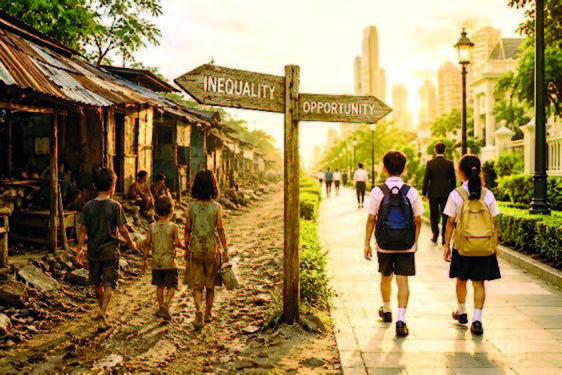
EVERYWHERE we look, life unfolds in unequal measure. One child opens his eyes to abundance, another to hardship. One enjoys health and strength, another bears illness from birth. Some possess remarkable intelligence, beauty, influence, or long life, while others struggle despite sincere effort. These differences are not confined to humanity alone. Throughout the living world, countless forms of life come into existence under strikingly varying conditions. Diversity is woven into the fabric of existence itself.
In search of a deeper explanation beyond the visible world, it points to the universal law of moral causation – Kamma or Real Creator. In its original sense, Kamma does not mean fate, luck, or divine reward and punishment. It means intentional action (Cetana). Every intentional act becomes a cause, and every cause possesses the potential to bear fruit when the appropriate circumstances arise.
No two beings inherit the same history of intention; therefore, no two lives unfold in the same way.
From this awareness, inequality is neither accidental nor the result of heavenly favour or punishment. Rather, it echoes the immeasurable diversity of intentional actions accumulated throughout the endless journey of Samsara, the beginningless cycle of birth and rebirth. Since no two beings have cultivated precisely the same patterns of generosity and selfishness, compassion and cruelty, honesty and deception, wisdom and ignorance, they cannot receive identical conditions of existence. Equality before the law is one of humanity’s greatest achievements; equality of karmic theory, however, is outside human option.
The Buddhist explanation of inequality is not an argument for blame, but for causation.
No one can know another person’s whole karmic history except the Buddha, and no status quo results from only a single cause. The present state of affairs also emerges through families, communities, institutions, and the countless interactions of society. Poverty should awaken generosity, not blame. Illness should inspire compassion, not condemnation.
The proper response to suffering is always wisdom joined with kindness. Modern civilization rightly seeks to lessen inequality through education, healthcare, just laws, economic opportunity, and social reform. Such efforts embody compassion and deserve wholehearted support. They can relieve suffering partially. Until now, they cannot entirely eradicate inequality itself because they cannot erase the distinct moral continuum carried by each living being.
If inequality begins in intention, then hope begins there as well.
The past influences the present, but it does not imprison the future. Every wholesome intention plants a new seed. Every act of generosity weakens greed. Every word of truth strengthens integrity. Every moment of compassion converts both individuals and surroundings. The Five Precepts, refraining from harming life, stealing, sexual misconduct, false speech, and intoxication, are profoundly hopeful for social harmony.
While complete equality of worldly conditions may forever remain beyond human reach, the freedom to cultivate wisdom, compassion, and moral excellence belongs equally to all. In that shared freedom lies the enduring hope of Buddhism, not the promise of identical lives, but the possibility that every life can move toward greater peace, deeper understanding, and ultimately, liberation.