Myanmar’s finished rattan products are overly dependent on foreign demand, accounting for 90 per cent of outputs while only 10 per cent are locally consumed, according to the Ministry of Commerce.
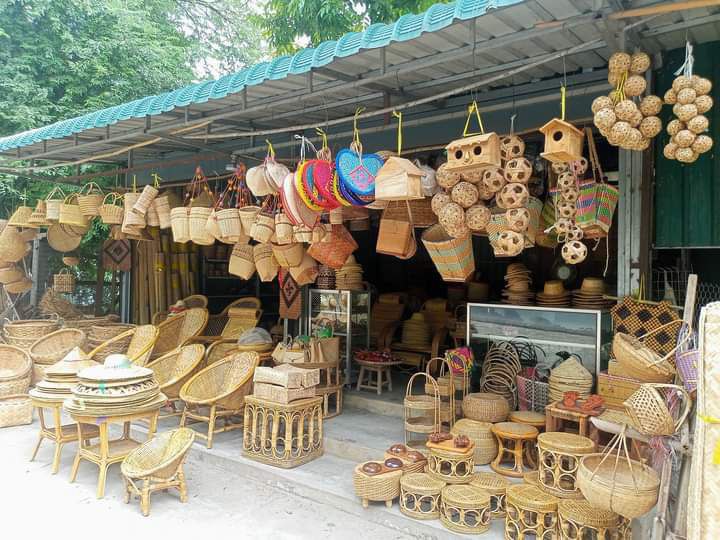
Bamboo and rattan products are supplied from Yekyi Township, Ayeyawady Region, with over 2,500 workers engaged in this business. Over 700 types of Bamboo and rattan furniture and décor, including cane ball, keychain, hat, footwear, basket, handbag, pen cup, tissue box, dust bin, plates, trays, table, chairs, sunshade, dressing table, box, garment rack, hat rack, lamps with unique and custom designs are exported. Over 80 per cent of the products are made of rattan, and 20 per cent of the products use bamboo.
Rattan business operators with skilled rural artisans in Yekyi Township produce finished products. Yangon-headquartered companies such as Bella Interiors, Classic Home and Glorious Family open branches in Yekyi town and run a business model where they supply raw materials to skilled artisans to weave or craft those materials into finished products or supply semi-processed rattan products to Yangon, from which finished products are manufactured and exported to foreign markets.
Raw materials from Ayeyawady Region and Rakhine State are designated for some furniture and locally used baskets. Top-grade and durable rattan raw materials are sourced from Taninthayi, Kachin, Chin and Sagaing areas for commercial production. Large companies from Yangon city leverage the traditional craftsmanship of local communities by supplying raw materials to artisans.
Semi-finished products are distributed in the domestic markets of Yangon, Mandalay, Sagaing, Pathein, Nay Pyi Taw, Kyaikto and Bago cities during peak season. Finished products are placed in markets of ASEAN, the Republic of Korea, the Netherlands, Denmark, Germany, Switzerland, Norway and the US. Only ten per cent of the total output is for domestic consumption, and the remaining goes to the foreign market. Eighty per cent of the rattan exports are supplied from Yekyi Township.
There is a customized order from business owners. There is a wide range of rattan products with appealing designs. They are sent to tourism destinations such as Ngwehsaung, Chaungtha, famous pagodas, the Bagan NyaungU Ancient Cultural Heritage Zone and big cities.
The rattan hat is priced at K3,000-K6,000 per piece. The prices range from K3,500-K5,500 per tray, K3,000-K3,700 per pen cup, K5,500-K8,500 per fruit basket, K7,500-K18,000 per bag and K5,500 per flower vase. The prices vary by size and quality. In addition to furniture and décor, Japan, Singapore, Australia and other countries also place orders for handbags, footwear and hats made of rattan.
In order to promote bamboo and rattan-based handicraft businesses, improved market access, an increase in production, rattan producers’ participation in domestic expo and international fairs and cooperation with departments and institutions concerned with technological upgrading. This business creates jobs for rural people with wages of more than K8,000-K9,000. The sectoral development will generate income and reduce poverty in remote villages in the township. It also contributes to foreign currency earnings and private sector development.
Myanmar’s traditional handicraft businesses allow residents to make a living without leaving home. Public-private partnership for sustainable raw material sourcing, technical upgrading, design innovation, capital financing and market expansion is being undertaken. This product will be listed as One Village One Product that can generate foreign currencies from high-end artisanal goods and contribute to the regional economic development. — NN/ KK