
Myanmar is implementing the re-establishment of forests, habitats for biodiversity species at natural conservation areas, and reduction of carbon emissions to prevent deforestation and degradation of forests.
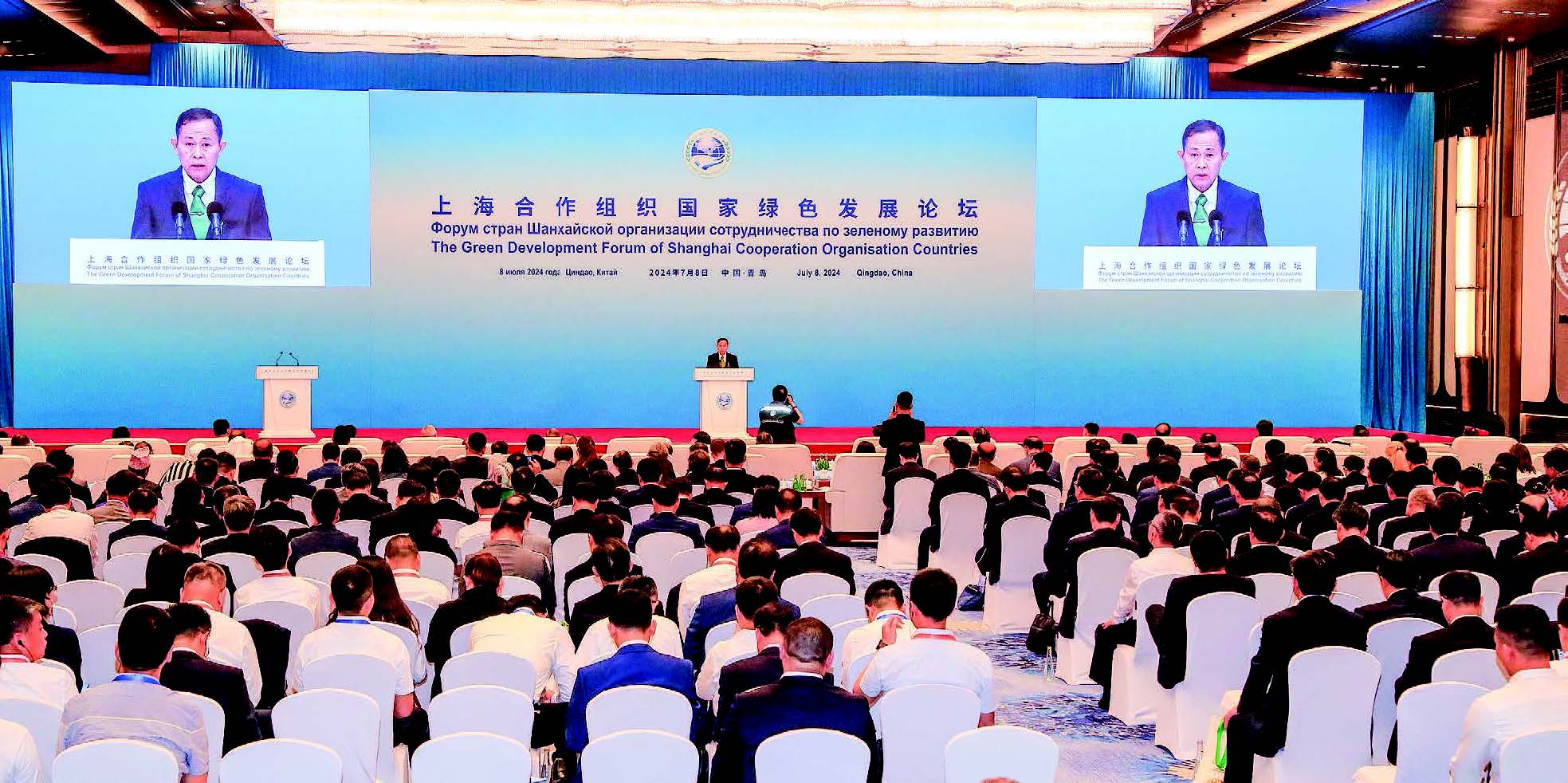
VICE-CHAIRMAN of the State Administration Council Deputy Prime Minister Vice-Senior General Soe Win delivered an address at the Green Development Forum of Shanghai Cooperation Organization Countries at Qingdao International Conference Centre in Qingdao of Shandong Province of China at 9:30 am Local Standard Time yesterday.
The Myanmar delegation led by Vice-Senior General visited the exhibition to mark the forum.
The Vice-Senior General and party attended the opening ceremony of the forum at Shanghe Hall of Qingdao International Conference Centre together with delegates, experts and officials from Kazakhstan, China, Kyrgyzstan, Russia, Tajikistan, Uzbekistan, India, Pakistan and Iran, observers from Afghanistan, Belarus and Mongolia, dialogue partners from Sri Lanka, Türkiye, Cambodia, Azerbaijan, Nepal, Armenia, Egypt, Qatar, Saudi Arabia, Kuwait, Maldives, the UAE and Bahrain.
At the opening ceremony, Mrs Shen Yueyue, Vice-Chairwoman of the National Committee of the Chinese People’s Political Consultative Conference and President of Good-Neighbourliness, Friendship and Cooperation Commission of the Shanghai Cooperation Organization, State delegates from SCO member countries, observer countries and dialogue partner countries delivered speeches.
Speaking on the occasion, the Vice-Senior General expressed his pride in accepting the congratulatory message sent by President of the People’s Republic of China Mr Xi Jinping to the forum.
He continued that this forum title is very meaningful, calling for the need to live in harmony with nature. As the earth and humans formed with biospheres are interrelated, everybody needs to take care of protecting the loss and damage in the natural environment caused by humans. So, as representatives and experts from SCO countries will hold discussions on ecosystem changes and biodiversity protection, innovation for energy transformation, transformation of living systems, and anti-climate change at the forum, today’s forum is a platform to enhance regional cooperation.
Greening development indexes are of great importance in encouraging sustainable development worldwide. The standards and norms of environmental management systems issued by the International Standard Authority are sound foundations for the establishment of effective green development for many countries.
Myanmar is prioritizing the promotion of investment in green development in order to improve the natural environment and ecosystem and ensure the long-term growth of the socioeconomy through nature-based ways.
As Green Economy and Green Growth Forums took place with the participation of stakeholders from ministries, organizations and various sectors and experts from ASEAN and the international community six times from 2011 with the aim of contributing to green economy development, outcomes from the forums contributed much to initiatives for the implementation of green economic policy.
The green economic policy framework has been drawn through collaborative efforts by representatives from relevant ministries, INGOs, and international experts. In this regard, the green economic policy framework was based on existing policies and strategies such as national environmental policy, Myanmar’s climate change policy, strategy and primary action plan, Myanmar’s national waste management strategy and primary action plan and Myanmar’s sustainable development plans.
The framework aims to increase investments that are responsible for reducing carbon emissions and green economic development to utilize natural resources efficiently. The framework comprises four green development principles and four objects to increase green economic investments in 11 prioritized sectors.
Myanmar has adopted the electric vehicle development policy for the development of EVs in the country in order to reduce the use of fossil fuel vehicles in the transport sector. At present, the Electric Vehicle Development Action Plan has been drawn in accordance with the mission and visions, procedures, and guidelines that have been adopted to implement the import and assembly of EVs systematically.
As Myanmar is blessed with good environmental resources such as extended coastal areas and vast waters, the blue economic sector development can contribute as a primary opportunity to achieving sustainable development for the long-term utilization of coast-based natural resources. Hence, the coastal resources multi-management plan has been adopted to implement relevant sectors. On the other hand, management has been made to extract natural resources in the long run. The valuable underground natural environment is under conservation, and everybody can observe the conservation of underwater and above-water natural resources in the southern part of Myanmar’s waters as part of implementing the green tourism development sector.
Moreover, forest and other land utilization sectors are essential in combatting climate change, conserving biodiversity, and ensuring the long-term stability of living styles and livelihoods. It is crucial to manage land utilization in a systematic way to initiate green development.
Efforts are being made to set 10 per cent of national lands as a natural conservation area and 30 per cent as forest reserve areas in order to contribute to the reduction of deforestation and combating climate change. At present, Myanmar has designated 59 natural conservation areas, including eight ASEAN heritage parks, seven Ramsar sites, two human and biospheres, eight East Asian-Australasian Flyways and 22 elephant protection-based tourism camps with enhancement of ecotourism services.
Aimed at raising understanding among the people on value of nature, Indawgyi Wildlife Sanctuary and Inlay Lake Wildlife Sanctuary were designated as UNESCO-recognized human and biospheres in accord with the standards of UNESCO.
Moreover, Myanmar is implementing the re-establishment of forests, habitats for biodiversity species at natural conservation areas, and reduction of carbon emissions to prevent deforestation and degradation of forests.
Likewise, community-owned forests were established with public participation, and private-owned forest plantations were set up to enhance the private sector. This monsoon, a total of 22 million saplings are being planted with the participation of the people as part of green movements.
Myanmar cooperates with international and regional countries in initiating international agreements such as the Stockholm Declaration of 1972, the 1992 Rio Declaration on Environment and Development, the Environmental Conservation and Development Programme-21, the 1992 Convention on Biological Diversity, the United Nations Framework Convention on Climate Change and the 2015 Paris Agreement.
In order to achieve success in the implementation of the 2015 Paris Agreement, Myanmar is generating electricity from solar, wind and hydro renewable energy for the development of the energy sector in adopting the vision of reducing sector-wise carbon emissions in the Nationally Determined Contributions (NDCs).
In this regard, Myanmar cooperates with international countries in implementing carbon reduction processes such as clean development, sustainable development, generation of electricity from waste in carbon credit cooperation, distribution of efficient stoves, and green development projects on the establishment and conservation of mangrove forests.
Myanmar plans to emphasize the promotion of cooperation with regional countries to encourage green investments, effectively assess and monitor environmental impacts, and enhance investments with the least emission of carbon to combat climate change through the promotion of government-private cooperation in order to contribute to a green economy for sustainable development of economic, social and environmental harmonization.
Today, humans are conserving natural beauties and ecosystems as well as destroying and utilizing these resources. Hence, all SCO countries and those from dialogue partner countries and observer countries need to harmoniously join hands with each other for further improvement of natural environments and ecosystems as well as long-term socioeconomic development as a public campaign among global countries.
As such, member countries need to promote green development technologies, enhance capacity for human resource development, raise funds, and further regional cooperation in the education and research development sector.
SCO countries and dialogue partner countries need to reaffirm commitments to green development. Myanmar takes pride in its participation in the SCO dialogue partner country starting from 2023 and expects further strengthening of partner relations and cooperation of member countries. It is necessary to shape the green development and sustainable future of new generations through the collaborative efforts of all stakeholders and experts with natural resources.
It is necessary to note that current endeavours can make decisions for the future of qualified new generations. Harmony between humans and nature is not an impossible opinion, and it is a requirement for strengthening human and their richness.
The forum issued the plan to initiate regional green development partnership relations and enhance sustainable development in the future.
Discussions on the endeavours of countries were held under relevant titles with the participation of delegates and experts from dialogue partner countries and observer countries.
These discussions were attended by Deputy Minister for Natural Resources and Environmental Conservation U Min Thu and Deputy Director-General Dr Hsan Oo of the Environmental Conservation Department, who accompanied the Vice-Senior General.
The SCO was formed with Kazakhstan, China, Kyrgyzstan, Russia, Tajikistan, and Uzbekistan in Shanghai, China on 15 June 2001. The Heads of State Meeting of SCO member countries was held in St Petersburg, Russia, in June 2002. The Shanghai Cooperation Organization Charter was signed, and it came into force on 19 September 2003.
The Shanghai Cooperation Organization is exercising its primary objectives to further cement mutual trust and neighbourliness among member countries, promote effective cooperation in political, trade, economic, research, technological and cultural sectors as well as education, energy, transport, tourism, environmental conservation and other sectors, develop sector-wise cooperation in the protection of regional security, stability and peace, and enhance fairly international political based on democratic system and economic landscape. The SCO follows the organizational policy based on disciplines such as placing emphasis on diverse cultures and mutual trust, mutual interest, equality, and bilateral coordination for common development. — MNA/TTA