It is necessary to continuously conduct research, evaluation and analysis to maintain stable and improved quality of cotton strains.
Myanmar, possessing favourable natural conditions and a strong foundation for successfully cultivating and producing cotton, can inevitably be developed into a cotton-exporting country, said President of the Republic of the Union of Myanmar U Min Aung Hlaing at the seminar titled “From Cotton Cultivation towards Textile Industry” at the city hall in Magway, Magway Region, yesterday morning.
The groups related to cotton cultivation and production industries expressed their wishes and hopes for production of quality cotton seeds through the contract system, import of foreign hybrid cotton strains, disbursement of loans to cotton seed oil production, distribution of agricultural inputs, supply of irrigation water, setting refence prices for cotton like paddy and rice, import of spare parts for cotton gins, modern machinery to produce yarns, production of textile rolls at home, import of raw dyes, linkages with foreign markets, designation of the Myanmar National Loom Day, supply of stable electricity round the clock, establishment of the spinning mill, and requirements of infrastructural and technological assistance from the government.
Union Ministers U Min Naung, U Myo Zaw Thein and Dr Charlie Than discussed the situations to fulfil the needs of those groups to ease difficulties in the production chain, and arrangements of relevant ministries for provision of capital, technologies, training, machinery and technical assistance and turning out human resources.
In his guidance, the President said that the President stressed the need to ensure that cotton cultivation is carried out properly with accurate sown acreage and correct statistical records. It is necessary to maintain stable cotton cultivation areas and achieve good yields in Mandalay, Magway, Sagaing and Bago regions.
He noted that to obtain high-quality cotton varieties, research and production are being carried out domestically, while cotton varieties are also being ordered and imported from abroad. Efforts must be made to achieve full production capacity of locally developed cotton varieties and to continuously conduct research, evaluation, and analysis to maintain stable and improved quality.
The President highlighted that cotton production requires conducting systematic research on domestic requirements and overseas market demand.
The President pointed out that as neighbouring countries and regional countries also have demand for cotton, Myanmar has to export high-quality long-staple cotton varieties to generate foreign exchange earnings and contribute to the enhancement of the national economy.
He stressed the need to undertake measures to resume the operation of former State-owned textile and garment factories, upgrade weaving machines, and introduce the use of modern weaving machinery. The State will provide capital loans to upgrade weaving facilities engaged in textile production in various regions and states.
To increase the country’s cotton production, the President underlined that it is necessary to carry out activities through a collective cooperative system. The State will assist in promoting the development of cotton ginning machines, spinning mills, and looms.
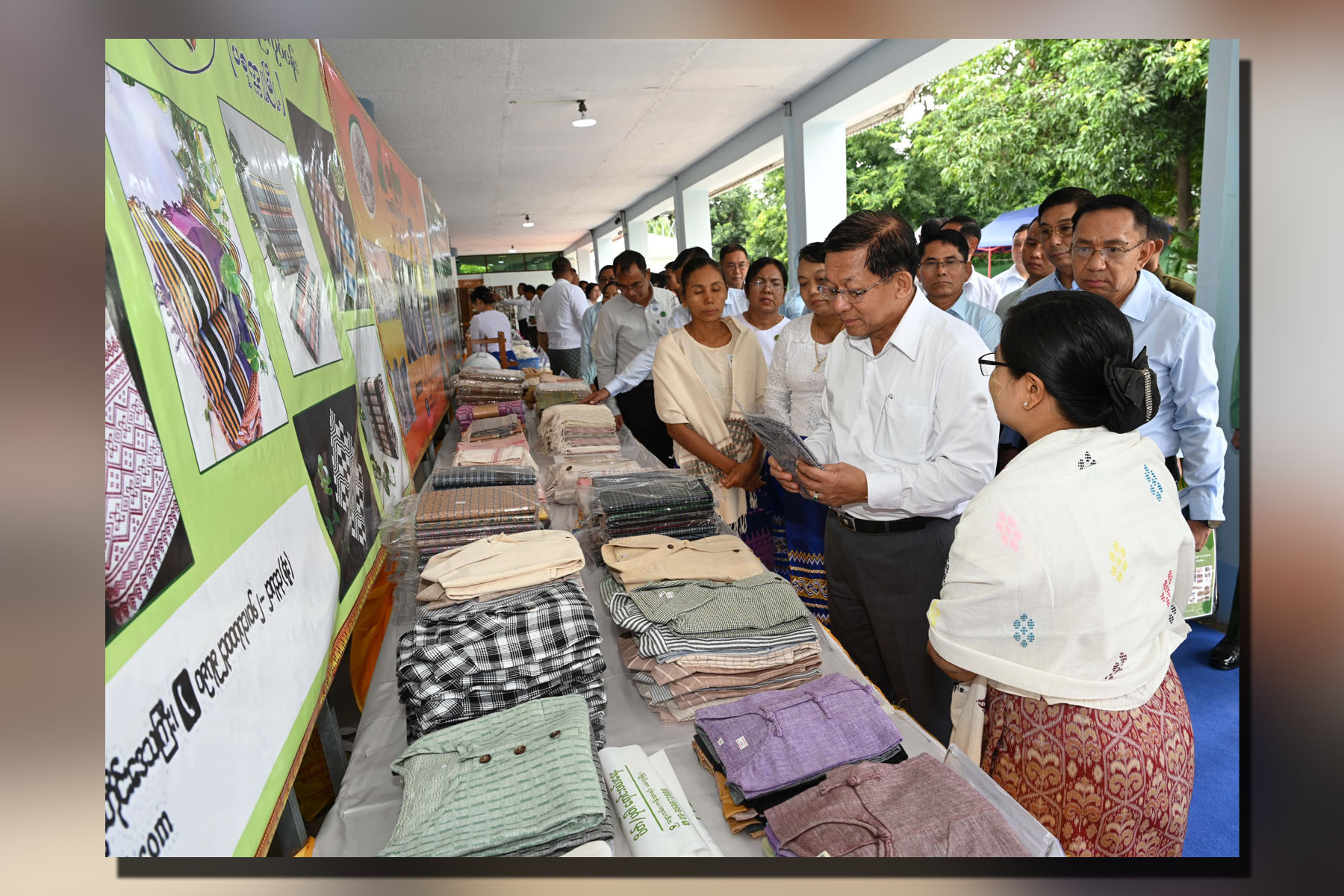
After the seminar, the President visited the booths on cotton cultivation and production displayed by relevant groups.
Also present at the seminar were entourages of the President, chief ministers of Sagaing, Magway and Mandalay regions and officials. — MNA/TTA