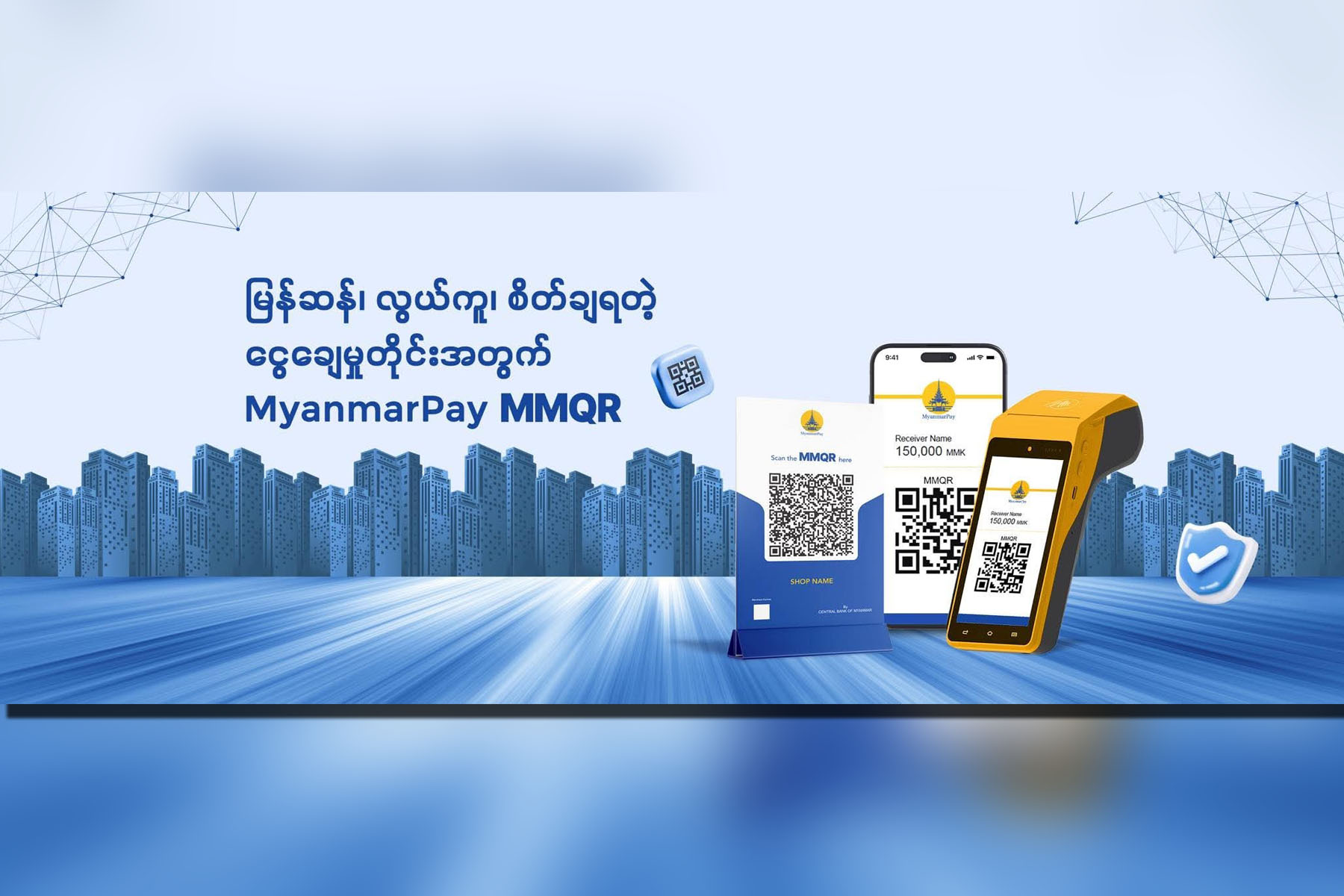
THE Central Bank of Myanmar (CBM) announced on 19 February that between 28 February 2025 and the end of January 2026, MMQR usage reached over 30 million transactions, totalling more than K12.7 trillion, with over 420,000 merchants and more than 24 million users.
CBM is systematically building a national payment infrastructure for a cashless payment system. It first established the CBM-NET, followed by the Myanmar Payment Union (MPU), eventually advancing to the current MMQR system.
Furthermore, under the CBM’s leadership, state-owned and private banks, financial institutions, and technology companies are transitioning from cash-based payments to a cashless system, where the public can reliably use mobile banking or digital payments instead of cash. The benefits include faster money circulation, increased transparency, integration of micro, small, and medium enterprises into the formal economy, and financial opportunities for rural people.
For that system, CBM studied and adopted the best practices of international models to ensure maximum efficiency, including the Unified Payment Interface (UPI) system of India, the PromptPay and National QR systems of Thailand, and the regulatory sandbox and cloud governance policies of Singapore.
MPU is a financial organization established as a domestic card scheme. By connecting ATM, POS, and e-commerce transactions through a Domestic Switching Platform, it ensures that payments are fast, easy, secure, and reliable. The objectives of the MPU are to reduce cash usage and increase card payment adoption. — NN/ZN