
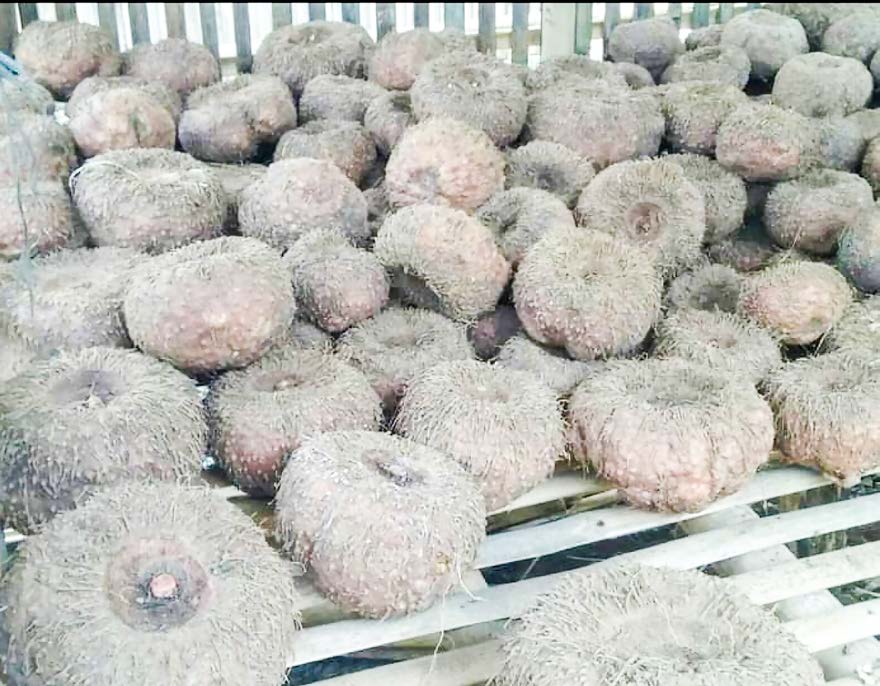
Konjac (elephant yam) commercial farming increasingly grew in Taninthayi Region and this business flourished in the region.
Residents in Taninthayi Region primarily rely on fisheries and perennial crops such as rubber, and areca nuts. At present, coffee, cocoa and konjac are cultivated under an intercropping system. Growers turn to commercial farming on a manageable scale. Konjac has foreign demand beyond domestic consumption. They are processed into dried konjac and powder with value addition and exported to Japan, Thailand and China. Konjac is rich in Glucomannan fiber. Konjac raw materials are utilized in food and beverage, cosmetics, traditional medicine and pharmaceutical industries with value addition. Even the byproducts can be used as animal feed.
“Konjac cultivation season starts in May-June and harvest season is in December. Cultivation costs K6 million per acre and generates K10 to K12 million income,” said U Thaw Zin Tun, head of the Agriculture Department in Palauk Town.
“Growers started to cultivate konjac in the town five years ago. Foreign demand enticed them to execute this business two years ago. This way, konjac cultivation expanded in the region,” he added.
Chin State is the largest producer of Konjac in Myanmar. Konjac is grown in Kachin, Shan, Mon, Kayin and Chin states and Bago, Sagaing and Taninthayi regions. High profitability and foreign demand prompted growers to cultivate konjac, according to the Agriculture Department.
Konjac cultivation is found in Yephyu, Kaleinaung, Dawei, Thayetchaung, Palaw, Myeik, Kyunsu, Taninthayi, Palauk, Bokpyin and Mawtaung areas. — Myint Oo (Myeik)/KK