
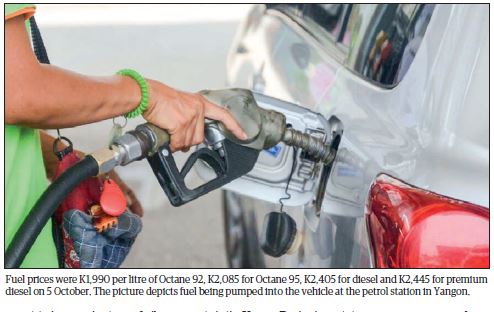
Fuel prices are moving down at a slow pace in the domestic market and Octane 92 price reached below K2,000 per litre.
Fuel prices were K1,990 per litre of Octane 92, K2,085 for Octane 95, K2,405 for diesel and K2,445 for premium diesel on 5 October. The prices touched a high of K2,440 per litre of Octane 92, K2,565 for Octane 95, K2,650 for diesel and K2,725 for premium diesel on 18 September. The figures showed a three-week decrease of K245-480 per litre.
The price index set by Mean of Platts Singapore (MOPS), the pricing basis for many refined products in southeast Asia, influences the domestic fuel prices, according to the Supervisory Committee on Oil Import, Storage and Distribution of Fuel Oil.
In August 2022, the oil prices hit the highest of K2,605 per litre for Octane 92, K2,670 for Octane 95, K3,330 for premium diesel and K3,245 for diesel.
The committee is therefore steering the fuel oil storage and distribution sector effectively so as not to have a shortage of oil in the domestic market and to ensure price stability for energy consumers.
The Petroleum Products Regulatory Department, under the guidance of the committee, is issuing the daily reference rate for oil to offer a reasonable price to energy consumers. The reference rate in the Yangon Region is set on the MOPS’s price assessment, shipping cost, premium insurance, tax, other general costs and health profit per cent.
The rates for regions and states other than Yangon are evaluated after adding the transportation cost and the retail reference rates daily covered on the state-run newspapers and are posted on the media and official website and Facebook page of the department daily starting from 4 May.
The committee is inspecting the fuel stations whether they are overcharging or not. The authorities are taking action against those retailers of fuel stations under the Petroleum and Petroleum Products Law 2017 if they are found overcharging rather than the set reference rate.
As per the statement, 90 per cent of fuel oil in Myanmar is imported, while the remaining 10 per cent is produced locally. The domestic fuel price is highly correlated with international prices. The State is steering the market to mitigate the loss between the importers, sellers and energy consumers. Consequently, the government is trying to distribute the oil at a reasonable price compared to those of regional countries. Some countries levied higher tax rates and hiked oil prices compared to that of Myanmar.
However, Malaysia’s oil sector receives government subsidies and the prices are about 60 per cent cheaper than that of Myanmar. Every country lays down different patterns of policy to fix the oil prices. Myanmar also levies only a lower tax rate on fuel oil and strives for energy consumers to buy the oil at a cheaper rate. — NN/EM