The current administration is prioritizing the revival and upgrade of long-delayed cross-border connectivity projects initiated by previous governments.
The major development projects aimed at strengthening the State economy should be assessed from four perspectives — political, administrative, defence and economic — and that both the advantages and potential drawbacks of such projects should be fully understood, said President U Min Aung Hlaing.
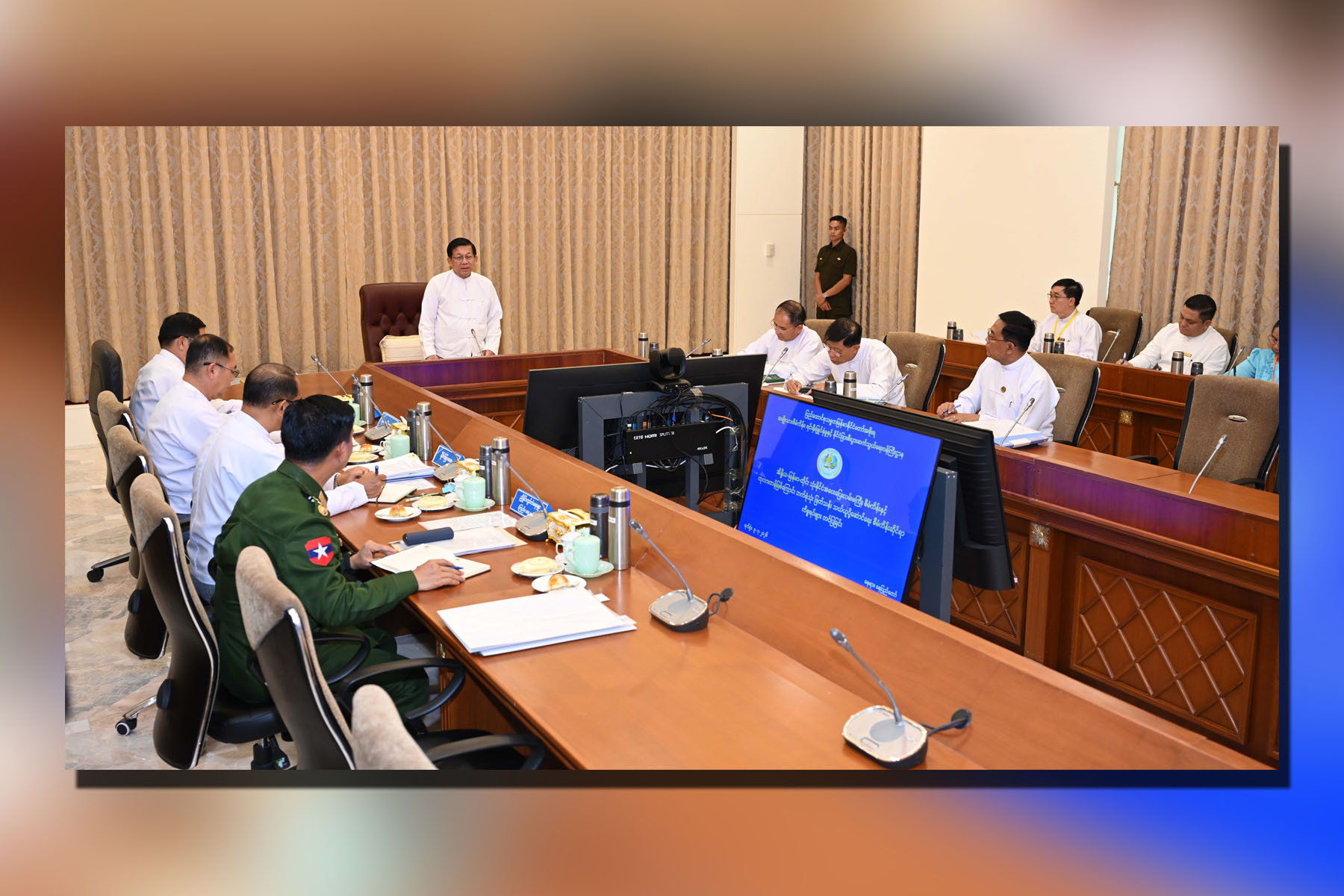
The President addressed a coordination meeting on the India-Myanmar-Thailand Trilateral Highway and Kaladan Multi-Modal Transit Transport Project yesterday.
In his speech, the President said Myanmar shares borders with five neighbouring countries and is connected to them through both land and water transport routes. These road and waterway links play a vital role in facilitating cross-border travel and trade. If border trade routes with neighbouring countries are systematically implemented and developed, they will significantly contribute to the country’s development and improve the socioeconomic well-being of its people.
Therefore, during the current government’s tenure, priority has been given to reviving and upgrading existing connectivity projects with neighbouring countries that had been initiated by successive governments but delayed due to various reasons. He urged all relevant sectors to work together to ensure that these projects are completed as quickly as possible during the current administration.
He continued that the Kaladan Project was officially launched in 2008, while some sections of the Myawady route were implemented under the government’s own programme, others received assistance from the Asian Development Bank (ADB). He emphasized the need for transport corridors to be interconnected. Regarding the India-Myanmar-Thailand Trilateral Highway, he pointed out that the three participating countries have different traffic systems, making it necessary to establish systematic traffic management arrangements. He added that while certain sections of the project are financed through the Union Budget, others are being implemented with support from the Asian Development Bank (ADB) and the Japan International Cooperation Agency (JICA). As these projects will bring substantial benefits to Myanmar, he stressed the need to expedite the implementation.
The President said the Monywa-Yagyi-Kalay-Tamu route would create investment and business opportunities through connectivity with six of India’s northeastern states. He added that expanded trade with China’s Yunnan and Sichuan provinces, Thailand, and Laos through eastern Shan State would further boost economic growth and regional development.
He emphasized that Myanmar has numerous important trade routes with neighbouring countries that should be implemented without delay. Successful implementation requires coordinated efforts in construction, security and legal enforcement. Necessary agreements between governments and relevant organizations should be finalized, and once security conditions improve, construction work should proceed simultaneously.
He further stated that border trade should be conducted directly between the governments of the two countries without the involvement of intermediary organizations. In addition to promoting border trade, greater efforts should be made to strengthen friendship and exchanges among ethnic communities living along the border that share common religious and cultural ties. Such people-to-people exchanges, he said, would also contribute to border security and stability. These strategic connectivity projects with neighbouring countries are important not only for the State’s development but also for strengthening bilateral relations, and so they should be implemented systematically and efficiently.
Union Minister for National Planning, Investment and Foreign Economic Relations U Aung Kyaw Hoe, Union Minister for Transport, Digital Development and Communications U Mya Tun Oo, Union Minister for Foreign Affairs U Tin Maung Swe, and Union Minister for Construction U Myo Thant reported on joint statement of Myanmar-India for the India-Myanmar-Thailand Trilateral Highway (IMT Highway) Project and the Kaladan Multi-Modal Transit Transport Project during the visit of the President to India, projects’ background and history, inclusion in the Greater Mekong Subregion (GMS) transport and economic corridors, project alignments, financing arrangements for each road section, progress made in implementation, and the construction of the two-lane Paletwa-Zorinpui road, singing of MoU, assignment of port operators, opening ceremony of Sittway Kaladan international port, arrivals of vessels and goods handling processes at the Sittway Kaladan international port, facts on framework for transport of passengers and cargo by road among India, Myanmar and Thailand, benefits of the completion of IMT Highway Project, Asian Highway (AH1), paving of Kalewa-Yagyi road, construction of 69 bridges on Tamu-Kyigon-Kalewa road, Phase I of ICP construction at Tamu border, and China-Myanmar Economic Corridor (CMEC).
Vice-President U Nyo Saw and participants coordinated the discussion.
After hearing the reports, the President delivered a concluding remark saying the major development projects aimed at strengthening the State economy should be assessed from four perspectives — political, administrative, defence and economic — and that both the advantages and potential drawbacks of such projects should be fully understood. He stressed the need for effective supervision and enforcement to prevent strategic highway projects developed for national progress from being exploited for illegal trade.
The President provided instructions that roads along these corridors must be continuously maintained to ensure they remain in good condition and meet the prescribed engineering standards. Proper drainage systems should be constructed to ensure effective water flow, and trees should be planted along the routes to create greener surroundings. If road construction projects are completed within the designated timeframe, trade and the flow of goods will increase significantly, contributing to State economic growth and improving the socioeconomic conditions of the people. He urged all relevant sectors to place special emphasis on ensuring the timely and successful completion of the projects.
Regarding border checkpoints, the President said that border management should be the sole responsibility of the governments of the two neighbouring countries concerned, and that no organization or third country should interfere in the management of border crossings. He added that the establishment of border checkpoints should also include systematic planning for staff housing, communications systems, water and electricity supply, and security arrangements.
The operations of the two projects discussed today are being resumed, and all should make an effort to accelerate the drive, and there should be proper management for the Bago, Hpa-an, Kawkareik, and Myawady-Thai border highway. He further pointed out that construction of strategically important highways linked to the China-Myanmar Economic Corridor (CMEC), a component of the Belt and Road Initiative, remains suspended and should be resumed as soon as possible. He urged all relevant sectors to work diligently to ensure that the strategically important highway projects included in major connectivity initiatives with neighbouring countries are completed in full during the current government’s term. — MNA/ KTZH