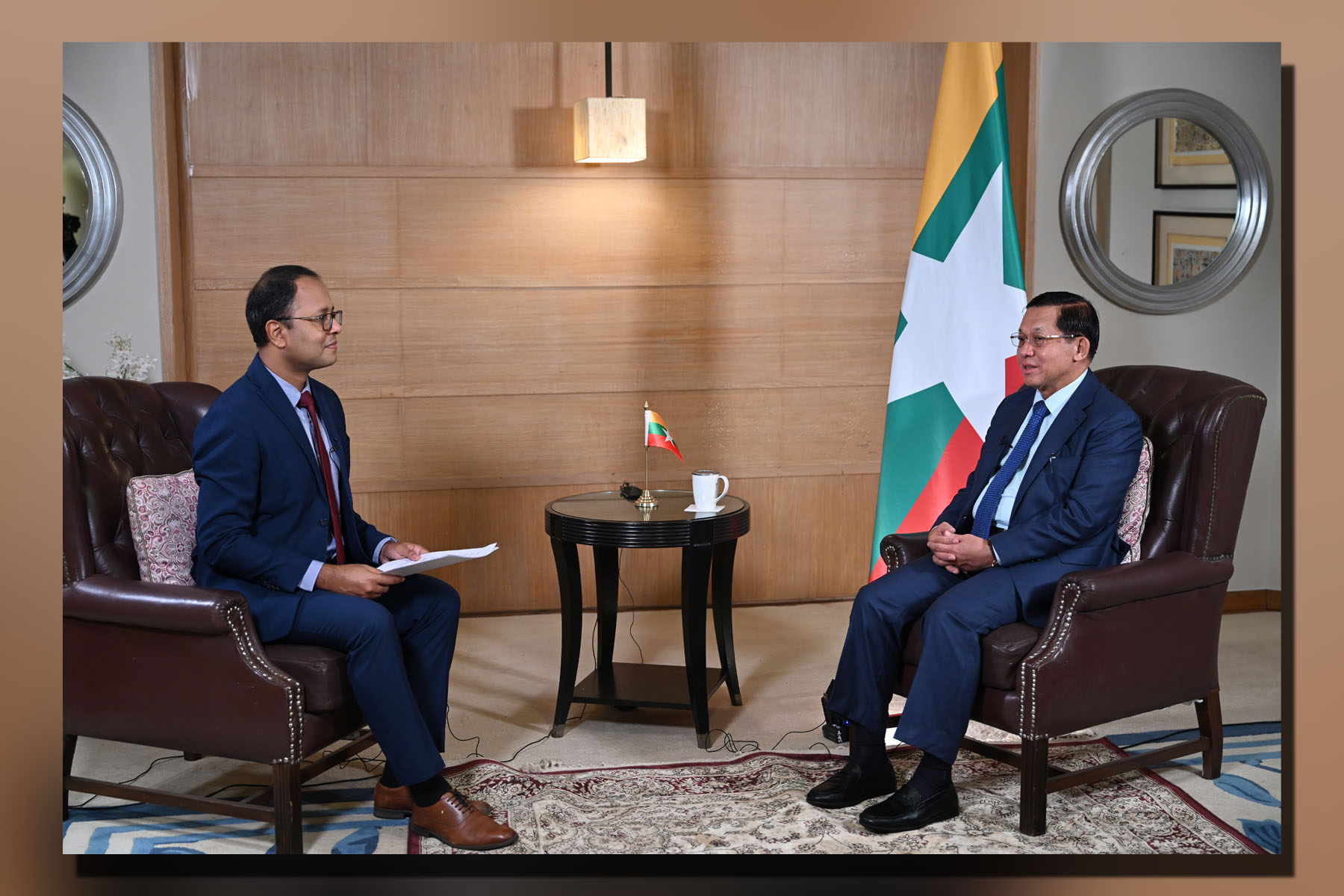
PRESIDENT of the Republic of the Union of Myanmar U Min Aung Hlaing responded to questions raised by Doordarshan (DD India News) during his official visit to India. The full text of the translated interview is as follows:
Q: Your Excellency, after becoming President, you chose India for your first visit. Now, India and Myanmar share significant cultural ties. How significant relations between India and Myanmar to you?
A: My initial plan was to attend an international conference on large feline species hosted by India. However, that conference was postponed due to the Ebola outbreak in an African country. In connection with that meeting, it has also been a long time since I last visited India – the last time was in 2019. Therefore, it was mutually agreed that I would attend the meeting in India while also undertaking an official visit. Although the conference was cancelled, I did not cancel this official goodwill visit and instead proceeded with my trip to India.
India is a country that has a long-standing history of friendly relations and cooperation with Myanmar. There are extensive ties between the peoples of both countries as well as between the two governments. Personally, I first visited India in 2010 and have been there many times since then. So, I consider India to be a neighbouring country that is appropriate and important for me to visit, and that is why I made arrangements to ensure this visit could take place.
Q: Mr President, how about the visit to the sacred Mahabodhi in Bodh Gaya? You spoke about significant ties in Buddhism. This highlights a significant cultural link between India and Myanmar.
A: Yes, I think so. Buddhism in our country was introduced through India. Bodh Gaya is the place where the Buddha attained enlightenment. Myanmar is also one of the countries with the largest Buddhist populations, so Buddhism is held in very high regard. The people of Myanmar also deeply revere Buddhism, and Bodh Gaya in particular is a place that Myanmar people greatly respect and hold in high esteem. Personally, I have visited Bodh Gaya four times. Whenever I travel to India, I always make arrangements to visit Bodh Gaya if possible. During this recent trip on 30 May, when we travelled from Nay Pyi Taw, Bodh Gaya is located along the way, so we specifically arranged to stop there. What is even more remarkable is that that day coincided with the full moon day of Nayon according to the Myanmar calendar – a highly significant full moon day. Because of this, being able to pay homage at Bodh Gaya on such a special day was regarded by our delegation as a particularly meritorious and meaningful experience. So, in terms of Buddhism, I would say that Bodh Gaya is also an important venue in the relations between our two countries.
Q: Your Excellency, Let’s talk about your meeting with Prime Minister Narendra Modi. What would you say is the key takeaway?
A: We emphasized many main topics in our discussions. The purpose of my visit included enhancing bilateral economic cooperation and promoting trade between the two countries. We discussed these matters extensively. We also talked about opportunities for investment from India in Myanmar, as well as how Myanmar could benefit from certain aspects of India’s development that are suitable for us. In addition, we discussed education, health, defence cooperation, maritime security issues, border-related matters, and sectors such as agriculture and livestock breeding. In short, the discussions were very broad and covered multiple sectors. Our meeting lasted for more than two hours, and I would say that we achieved successful outcomes from the discussions.
Q: Mr President, we spoke about the economic ties. Now, we understand the volume of trade between India and Myanmar stands at around US$2 billion at the moment. Also, India is Myanmar’s largest trading partners. How would that is the India-Myanmar Business Forum meet what you looked for?
A: That is correct in what you are saying. India is a major trading partner for Myanmar. The annual bilateral trade is over US$2 billion. Myanmar’s exports are higher, while India’s imports are relatively lower. I explained how Indian imports could be facilitated. For example, there are iron and steel products, pharmaceuticals, and textiles. These are the kinds of goods we are discussing in terms of expanding exports to Myanmar. We would import these items as well. We also explained this to Indian businesspeople: they could come to Myanmar, invest, and carry out manufacturing. Then they could sell not only to the Myanmar market but also to neighbouring countries such as Laos, Cambodia, and Vietnam. It is not limited to the Myanmar market alone. Myanmar’s population is only about 50 million, but if we combine it with neighbouring countries, it could create a regional market of nearly 200 million people. Therefore, we encouraged efforts to access and sell to this broader market. Many have shown interest. The main point is to promote trade. You mentioned earlier that trade volume is about US$2 billion. We are targeting US$3 billion as a first step. In the next phase, in the near future, it will be expanded to $5 billion. From there, we will gradually continue to expand step by step. Myanmar’s exports to India are substantial. For example, there are pulses, forest products, and mineral-related exports. There are also other agricultural and livestock-related export products. Rubber, for instance, is one example. In the textile sector as well, we can cooperate in cotton-related industries. There are areas where both sides can cooperate. The main point is that people are interested when mutual benefits can be achieved. Interaction and trade are also based on mutual interests. However, as I said yesterday, the focus should not be only on profit, but on increasing the volume of trade. We should aim to sell more with lower profit margins. Myanmar will also try to sell more with lower profit margins. India will also try to do the same. This is necessary. Of course, traders naturally consider profit. But I emphasized not to prioritize it too much and take reasonable profit. The main goal is to increase value and expand trade volume. That is the direction we want to move in.
Q: India follows the “Act East” policy and the “Neighbourhood First” policy. The 2025 devastating earthquake struck Myanmar, and India was one of the first responders. These are different capacity-building initiatives that are being implemented in Myanmar. How would you look at New Delhi as a development partner?
A: In terms of development, there are many sectors. In addition to what I mentioned earlier, there are also areas such as education and health. Then there is the cultural sector as well – for example, the preservation of ancient heritage sites. In industry as well, if we want long-term development, we need significant industrial growth. There is also the IT sector. India is one of the leading countries in IT. Therefore, if we cooperate with India in IT, there will be many opportunities for us. In Myanmar, we are also implementing an IT-related city development project called Yadanabon Cyber City in Upper Myanmar. It is located in PyinOoLwin, which was formerly called Maymyo. During the colonial period, it was well known as a resort town. We are now redeveloping it as an IT city. If Indian IT companies and professionals come and operate there, there will be many opportunities. The scope is quite broad — it is a large-scale undertaking. India is also a country with extensive experience in this field. Therefore, if we work together, I believe India can provide substantial support to us.
Q: Your Excellency, the major connectivity project, for example, the India-Myanmar-Thailand Trilateral Highway project, has been in place for many years. And, what about your visions for the project, your vision for connectivity in the region?
A: This India-Myanmar-Thailand Trilateral Highway project, which connects Myanmar, Thailand, and India, is over 800 miles long. The Thailand-Myanmar sections are already largely open and operational, with traffic already moving along them. The Indian side, however, is the most important part. In India, the connection from the Northeast region linking Tamu and Moreh is a key gateway route. This corridor is particularly important for India, first for enabling Indian products to enter Myanmar through border trade, and second for allowing Indian citizens to travel and engage with Myanmar via the border crossing. These two aspects are the main priorities. However, due to the security situation, there have been some difficulties in certain areas, and the project has been temporarily stalled. We are now working to improve the security situation.
Following the developments in Myanmar in 2021, instability emerged in those areas. At present, Tatmadaw is working to stabilize those regions. Very soon, we are also making efforts to reopen the key route connecting Kalay and Tamu, which is an important border-adjacent city. Once that is completed and the border gate is reopened, it will become possible to travel from central Myanmar through to Thailand. Overall, restoring normal conditions in the Myanmar-India border areas is the most important priority. We are giving this top priority. I would also like to emphasize that this is a project we regard with very high importance.
Q: Your Excellency, Let’s talk about some areas of concern. India and Myanmar share a long, porous border, I think an over 1,600-kilometre-long porous border. Now this border is also exploited by insurgents, by transnational narcotics networks. What can the two countries do better to control such challenges? And can you assure India that Myanmar’s soil will not be used for anti-India activities?
A: These armed conflicts and drug-related problems are largely rooted in politics. In the past, our political system was a centralized, government-led system. Later, there were disagreements and divisions. There were also ethnic armed organizations, as well as groups demanding ethnic rights. These factors led to the emergence of armed conflicts. From these conflicts, drug production expanded significantly as a means for them to sustain themselves. However, around 2020, we had reached a situation where we were able to control it to a considerable extent. But in 2021, due to political instability, drug production grew further. We are now carrying out strong crackdowns and enforcement actions against this as well. We have been sharing intelligence from India, and arrests have also been made in India, so to a certain extent, drug suppression efforts on both the India-Myanmar side have been relatively under control. However, there is still work to be completed. To achieve that, Myanmar needs to ensure political stability. Since we are moving toward a democratic system, our government will continue to strengthen democracy. In doing so, issues arising from democratic and political demands, as well as ethnic-related demands, need to be addressed through systematic democratic negotiations and solutions. If we proceed in this way, armed insurgencies will be reduced to some extent, and this will also place significant restrictions on drug production. Therefore, we need to proceed in parallel; only then can we achieve results. Because there are armed insurgent groups, those who oppose India for various reasons are also taking advantage of them and creating disruptions along the India-Myanmar border. I believe that if we address all of these simultaneously, the situation will be resolved. To some extent, we have already made progress in resolving it.
This morning as well, during discussions with the Prime Minister of India, I explained this matter. The areas along the India-Myanmar border are densely forested regions, making travel extremely difficult. During the rainy season, it becomes even more difficult. I have personally visited these areas many times. I also served as a commanding officer of the battalion in that region, so I know it very well. Therefore, regarding this region, we are currently making efforts to improve the security situation before the rainy season begins. If the security situation improves, then, in relation to the question raised earlier—issues related to ethnic groups, armed conflicts, and disturbances to peace and stability, as well as drug-related issues—will significantly decrease, I believe. I am confident that we will be able to fully resolve these matters in the near future.
Q: If you talk about the internal challenges facing the country over the past five years, we understand have been turbulent. How do you reflect on issues of democracy, peace, and stability? What do you think are the biggest hurdles facing the country at the moment?
A: Peace is the most important condition. The next is security. The reason there is no peace is because of differences in viewpoints and disagreements. To reduce these differences, we will work to achieve peace. On the day I assumed responsibility, I told both the Hluttaw and the nation that I would strive to achieve peace within 100 days and to bring peace to the country within five years. We have extended invitations for peace and will proceed through negotiations. After discussions, we must move forward together. At the same time, we also need to work on security and the rule of law. Groups are opposing us through terrorist acts. These can be divided into two categories: one is EAO, and the other is PDF. EAO stands for Ethnic Armed Organizations, and PDF stands for People’s Defence Forces. PDFs are groups that emerged after 2021 due to political disagreements. EAOs are armed organizations that have existed since independence, arising from various ethnic-related issues. Therefore, if we look at these two categories separately, we will first prioritize addressing the PDFs in terms of both peace and security.
After that, as for the EAO groups, we will approach them through the peace process. We have already been holding discussions for quite some time. Their demands are quite diverse, so these issues need to be addressed carefully. There are many things they want, of course. But instead of talking about everything one wishes for, it is better to focus only on what is possible and what is appropriate. You may also have many desires – you may want this or that – but if you try to pursue what is not possible, it will not work. In our country, there are many ethnic groups; there are over 130 ethnic groups, with eight major ones. Your country has even more. Therefore, since viewpoints differ in many ways, how do we resolve this? We resolve it through law. We will resolve it according to the Constitution, and we will work to ensure that within the Constitution. We must focus on what is acceptable to the majority and what is feasible; we cannot insist on what is not possible. That is why I emphasize that peace is the most important issue. After that, we must move towards development. It is the government’s responsibility to develop the country. When carrying out development, it must include all the people – not only ethnic groups but the entire population. We must implement inclusive development that covers everyone. Only by proceeding in this way can we move forward. Therefore, the most important thing is peace – number one. The second is stability and security, which must continue to be maintained. At the same time, development work must also proceed in parallel. This is the approach we intend to take. This is my position.
A: ASEAN is an organization that holds significant influence both in the region and globally. We would like to know your views regarding the current relationship between Myanmar and ASEAN.
A: The relationship is generally good with most ASEAN member countries. However, ASEAN’s policy of “consensus” – meaning all members must agree upon decisions – is what has created difficulties. One or two ASEAN member states hold rather firm or tough positions towards Myanmar. But most ASEAN countries have positive views towards us. In the past, ASEAN’s approach towards us changed based on our actions following the election results. However, we have now held the general elections in December 2025 in a fair and free manner. This cannot be denied. A total of 54.22 per cent of eligible voters participated. Among them, nearly 50 per cent were young people between the ages of 18 and 40. Nearly half of the voters were youths. We cannot force these young people to vote—they would simply run away if pressured. But they came and voted voluntarily. If you look at election reports and images, you can see that they participated actively on their own initiative. As for the voting system itself, we implemented a system that makes electoral fraud virtually impossible. We also ensured that everything related to the voter list and the election process was conducted in a way that is free and fair. That is why we invited international representatives to observe the elections and results. When they came, they all accepted the process; none rejected it. So far, no party or candidate has filed any complaint regarding the election results. ASEAN is also aware of this. Furthermore, if ASEAN recognizes that we have corrected the issues related to the election and improved the process, there are member countries that are willing to accept this.
Therefore, we maintain friendly and respectful relations with ASEAN. However, because ASEAN decisions are based on consensus, when one or two countries take a hardline position, it becomes difficult for other countries to engage with us in a normal way as well.
However, at present, we do have good relations. On an individual level as well, I maintain good relations with them. When I was elected President, many ASEAN countries sent congratulatory messages. From this, it can be said that we have good relations. We also have a positive view towards ASEAN.
Q: Your Excellency, as we conclude our conversation, what is the key message you wish to communicate to the global audience about Myanmar’s future?
A: Myanmar, our country, is now steadily moving along the path that our citizens aspire to. Myanmar is also ready to work together with the world. Therefore, we would like others to come and observe our reform efforts. We would like them to come and see the current situation on the ground. Then, it would be better to engage in cooperation with us regarding the country’s development. If cooperation is carried out with us, opportunities will arise to improve the current living conditions of the people of Myanmar and to enhance their livelihoods in all aspects. Therefore, we would like the world to come and observe this and to cooperate with us. Myanmar is truly, correctly, and firmly moving forward on the right path chosen by the people.
However, the term “standard” itself has many different meanings. Standards differ from country to country. Just as India’s standards are different from those of other Asian countries, they are also different from Western standards. Even within democracy, benchmarks are not the same everywhere. Myanmar is also pursuing a democratic system that is suitable for its own context. In politics, we have two main goals: first, to firmly establish a genuine multiparty democratic system; and second, to build a Union based on democracy and a federal system. These are our objectives. We are working accordingly. I would like to tell the world that we will continue to pursue this course steadily and without deviation.