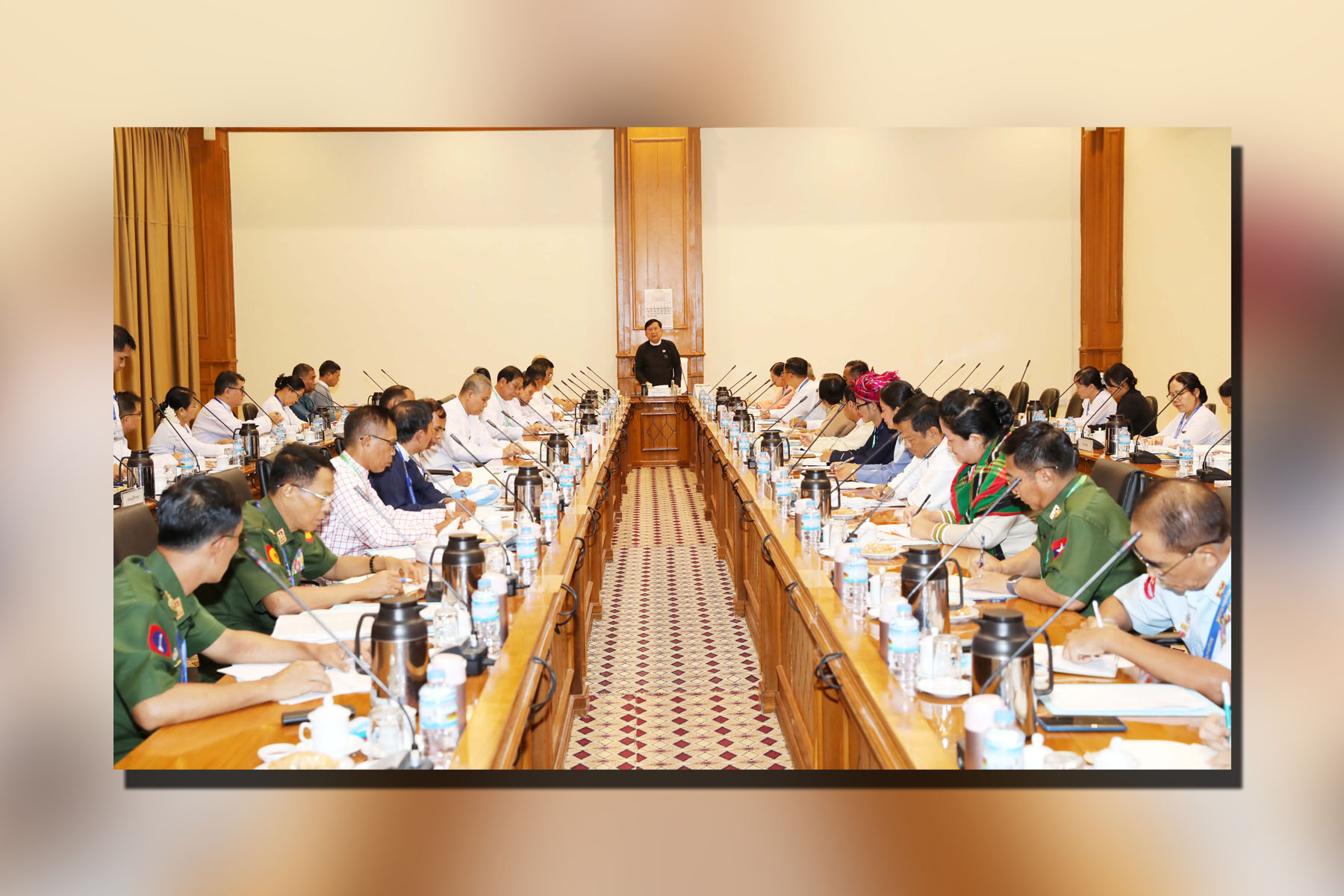
THE international community dubs the Joint Bill Committee and the Joint Public Accounts Committee as Sub-Parliaments, said Speaker of the Pyidaungsu Hluttaw and the Amyotha Hluttaw U Aung Lin Dwe at the meeting with the two joint committees at the convention hall of the Pyidaungsu Hluttaw building in Nay Pyi Taw yesterday afternoon.
Speaking on the occasion, the Speaker noted that members of the Joint Bill Committee are required, in accordance with Rules 127, 128, and 129 of the Pyidaungsu Hluttaw Rules, to ensure that any recommendations submitted by the committee regarding any bill within the scope of the committee’s duties and powers must be relevant to the matters contained in the bill.
He continued that committee members shall have the right to freely speak, discuss, and vote in committee meetings, provided that such actions do not contradict the provisions of the Constitution and parliamentary laws. However, it is particularly required that discussions shall not be disclosed outside the committee, and meeting records shall not be circulated or distributed.
He stressed that as a Joint Bill Committee, all types of bills except those that have been agreed upon by both Hluttaws must be reviewed and analyzed by the committee, and the committee is required to submit its comments and observations. These include bills that are initially debated in the Pyidaungsu Hluttaw, bills on which the two Hluttaws have reached differing views, and bills returned by the President with comments.
The Speaker underlined that the committee shall continue to carry out each stage of the legislative process in accordance with the Pyidaungsu Hluttaw Law and Rules, starting from deliberations within the legislature up to the point where the bill can be submitted to the President for promulgation as law.
He pointed out that the Joint Public Accounts Committee is also required, under Section 100 (b) of the Constitution, to conduct a detailed examination of the annual national development plan and the annual estimated budgets that are to be discussed and decided upon in the Pyidaungsu Hluttaw. In accordance with Rule 131 of the Pyidaungsu Hluttaw Rules and the provisions of the Union Budget Law, the committee shall scrutinize matters relating to state revenues and expenditures based on the report of the Auditor-General of the Union. In carrying out such scrutiny, it shall examine whether the projected revenues submitted to the Hluttaw have been fully collected; whether the authorized expenditures are being spent in accordance with financial rules and procedures for the designated purposes; whether the funds are being used effectively; and whether there are any instances of wastage, leakage, damage, losses, misuse, or misappropriation in the implementation of projects. If necessary, the committee may conduct field inspections with the approval of the Speaker. The committee shall also review the compliance of relevant ministries and organizations with the recommendations of the Office of the Auditor-General of the Union. In addition, the committee must review and analyze reports on the national planning, budget and taxation (biannual and annual) as well as loan-related reports.
Chairman of the two joint committees, Deputy Speaker Jeng Phang Naw Taung, urged the committee members to carry out their assigned duties thoroughly within a five-year term.
The Permanent Secretary of the Pyidaungsu Hluttaw clarified the responsibilities of the two joint committees, and the Speaker gave a supplementary discussion. — MNA/TTA