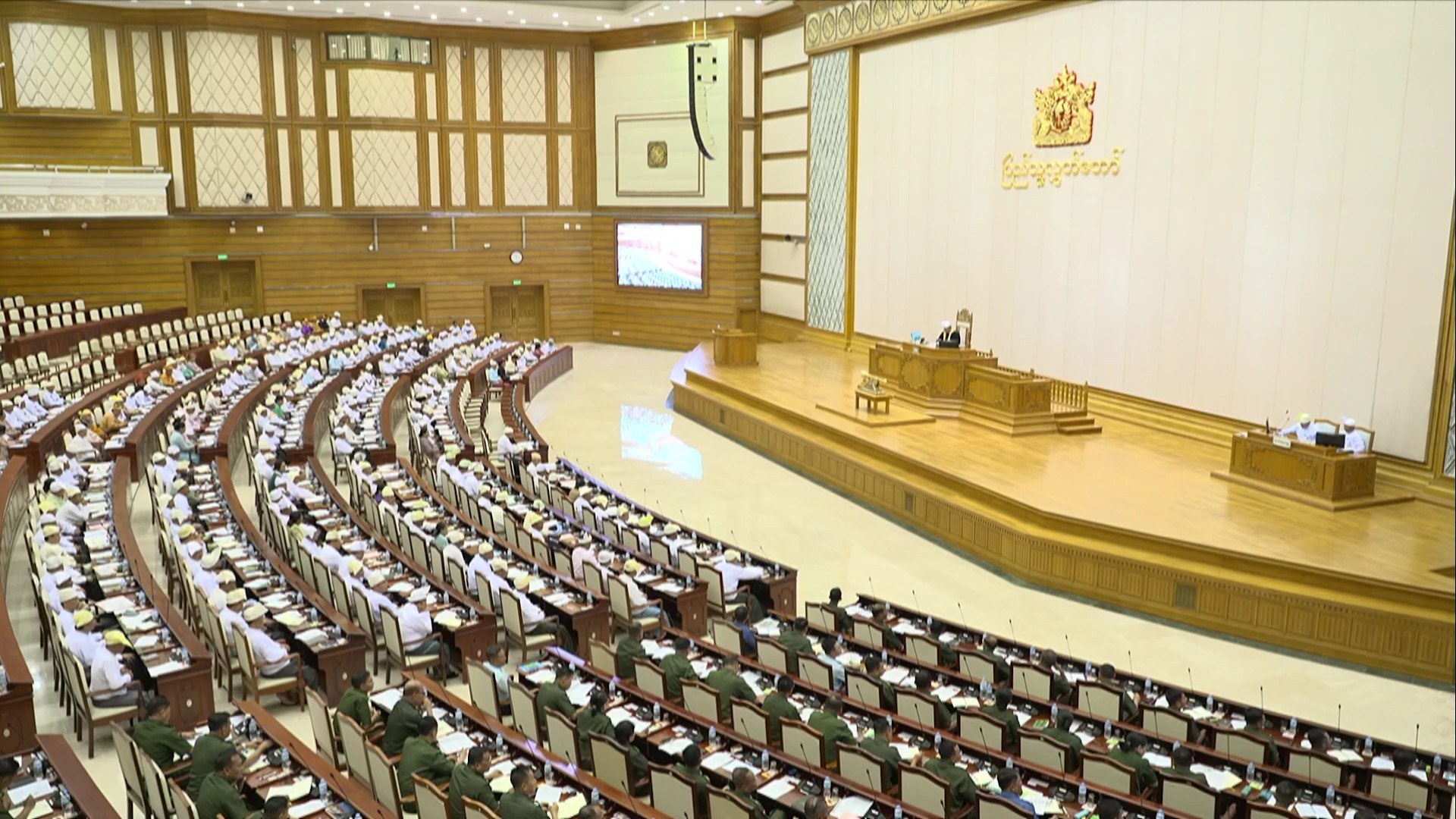
THE second-day meeting of the second regular session of the Third Pyithu Hluttaw commenced at the convention hall of the Hluttaw Complex in Nay Pyi Taw yesterday morning.
Pyithu Hluttaw Speaker U Khin Yi announced that, out of 351 Pyithu Hluttaw representatives entitled to attend the second day of the second regular session of the Third Pyithu Hluttaw, 349 were present at today’s meeting, resulting in an attendance rate of 99.43 per cent. Accordingly, it was declared that the meeting had achieved quorum and was duly opened.
At the meeting, Nay Pyi Taw Council member U Khin Maung Latt replied to the question raised by U Tin Aung Chit from the Aunglan Constituency.
He stated that vehicles from villages near the camps, as well as those registered within the designated mileposts of the Bwatgyi entrance and Kyeni Chaung exit gates, are granted free passage. Meanwhile, vehicles from Aunglan pay a single-use toll at the Kyeni Chaung exit gate, which is waived if they return within one hour.
The Max Highway Co Ltd (BOT) carries out annual road upgrading, maintenance and repair works along the 61 miles seven furlongs of the Aunglan-Kopin Road in Aunglan District. Emergency works are also undertaken whenever flooding occurs.
He further explained that relocating the Aunglan (exit) (Kyeni Chaung) gate beyond milepost 231/5 outside the Aunglan Township boundary will reduce toll revenue collection, resulting in lower tax revenues for the State and weaker control over overweight vehicles, which could cause greater damage to roads and bridges. Therefore, relocating the toll gates outside the township boundary would not be appropriate.
Member U Khin Maung Latt made clarifications regarding the questions raised by U Hla Swe from the Pobbathiri Constituency.
He said that the intervillage road of Thitseintpin tract Chinsu Kyapin Inn villages is currently four miles long.
Upgrading it into a macadam road will require a minimum road width of 24 feet. If the macadam road project could be implemented, it would benefit four villages with 754 households and a population of 2,842 people.
Therefore, starting from the 2027-2028 financial year, the macadam road construction project for the road section from the inter-district road to Thitseintpin village in Tatkon Township will be proposed and implemented in phases, depending on the availability of Nay Pyi Taw Council capital funds.
Deputy Minister for Agriculture, Livestock and Irrigation replied to the questions raised by U Thein Tun Oo from the Amarapura Constituency. He stated that filters to block water hyacinths will be installed at the water inflow points into Taungthaman Lake to prevent further spread. To preserve the natural beauty of Taungthaman Lake and the U Bein Bridge throughout the seasons, the Mandalay City Development Committee has been carrying out daily cleaning operations and planting flowers around the lake and bridge areas. The Department of Fisheries supervises fish breeding operations in the lake through an auction with fishery operators. Therefore, the Department of Fisheries and fishery auctioneers will continuously supervise and carry out the removal of water hyacinths to ensure the lake surface remains clean and free of hyacinths.
Water hyacinth removal operations had previously been carried out with assistance from the city development committee using a backhoe, fuel and labour support from the lake leaseholder. However, the work has been temporarily suspended due to fuel shortages. The holder of the Taungthaman Lake grant is continuing limited operations using a small hyacinth-cutting raft. Efforts are also underway to clear water hyacinths along drainage channels to help increase cultivable farmland areas.
Deputy Minister U Bo Bo Kyaw also replied to the questions raised by U Khin Maung Than from the Kalay Constituency. He said that more than 300,000 pits of sediment had been dredged from the Yezagyo Dam near Yezagyo Village in Kalay Township, Sagaing Region, from the 2015-2016 to 2022-2023 financial years, depending on available funding.
No dredging work was carried out during the 2023-2024 financial year due to local security conditions. However, in June and July 2025, sediment and debris blocking the water intake structure were removed to resume irrigation water supply and electricity generation. In August 2025, electricity generation had to be suspended again because of excessive sediment and debris inflows. Water overflowing from the spillway was diverted into the main canal to irrigate monsoon paddy fields.
He added that feasibility studies will also be conducted to implement related works to ensure full irrigation coverage and regular electricity generation. Sediment removal from the dam requires considerable time due to the massive scale and high costs involved.
He also made clarifications for the questions raised by Sai Sein Win from the Laikha Constituency. He replied that agricultural technicians specializing in soil, seeds and diseases from the Department of Agriculture are providing technical assistance for crop cultivation.
The Agricultural Mechanization Department is also arranging to sell 15 large tractors, 650 hand tractors and 10 harvesters directly to farmers during the 2026-2027 financial year. To enable farmers to purchase agricultural machinery, dryers, warehouses and rice mills, loans with an interest rate of six per cent are being provided, with loan amounts increased to up to K 300 million for one sector and over K300 million for another sector, as announced in state-owned newspapers on 4 April 2026.
Regarding the availability of land for crop storage facilities, it would need to comply with farmland laws and regulations. To create crop markets, agreements have been signed with China’s General Administration of Customs covering nine approved crops and commodities, and arrangements have been made for seven commodities to be exported to the Chinese market.
To secure markets for agricultural products, the government is increasing crop loan rates, expanding agricultural machinery loans, ensuring the availability of agricultural inputs, promoting contract farming systems, encouraging productivity targets, educating farmers on the combined use of natural and chemical fertilizers to reduce input costs, and providing agricultural inputs through the State Economic Promotion Fund with a crop-based payment system.
He then replied to the questions raised by U Sai Sam from Mongyan Constituency. He stated that local farmers have been diverting water from the Namlwe Creek using a self-built temporary dam made of logs and bamboo for cultivation purposes. That self-built temporary dam is frequently damaged due to the heavy rainfall in the rainy season. Therefore, in order to enable double-cropping on 160 acres of farmland in Wamtawng Village, the construction of a stone masonry concrete diversion weir will be proposed under the 2027- 2028 state budget or other appropriate funding sources for implementation.
A proposal of Dr Win Htay from the Ingapu Constituency urging the Union government to form prize stabilizing committee for farmland areas was submitted to the Hluttaw, and the Hluttaw agreed, and an announcement was made that those who want to discuss that motion can nominate.
The Pyithu Hluttaw Speaker submitted the formation of a committee on domestic and international non-governmental organizations to the Hluttaw.
The Deputy Speaker clarified the duties, authorities, rights, terms and meetings of the committee.
The Speaker submitted to the Hluttaw that the committee will be formed with 15 members, and duties will be assigned to U Thet Pon from Sagaing Constituency as chair and U Tun Lwin from the ChaungU Constituency as secretary.
The Pyithu Hluttaw will continue its third-day meeting of the second regular session at 10 am on 5 June. — MNA/KTZH