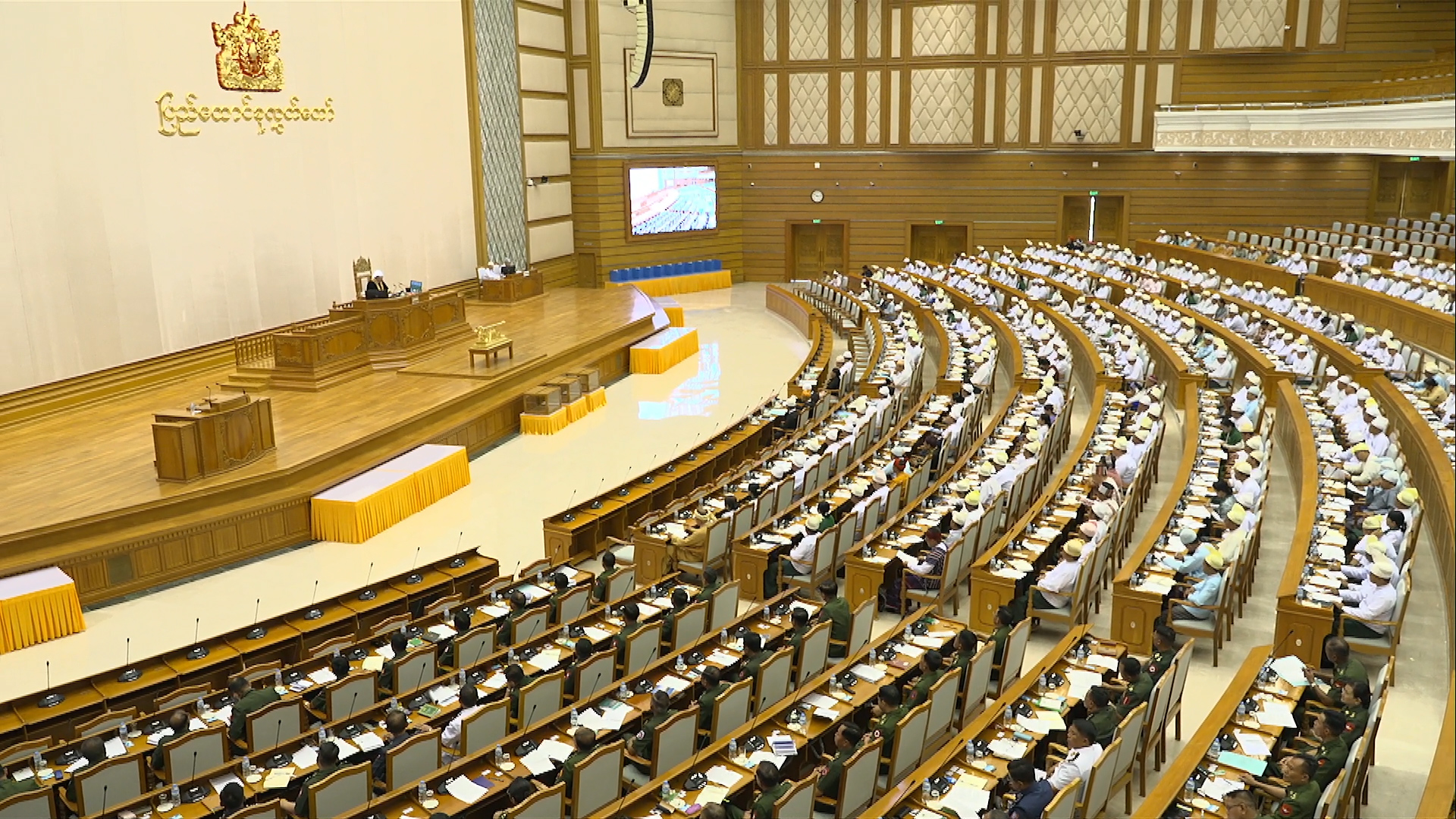
CARE must be taken to avoid any form of interference or attempts at domination that could lead to friction between the different parties or institutions, said Pyidaungsu Hluttaw Speaker U Aung Lin Dwe at the second regular session of the Third Pyidaungsu Hluttaw, which commenced for the first day at its convention hall at the Hluttaw Complex in Nay Pyi Taw yesterday morning.
The first-day session was attended by 558 out of 560 Hluttaw representatives, accounting for 99.64 per cent.
At the outset, Pyidaungsu Hluttaw Speaker U Aung Lin Dwe extended greetings, saying that Hluttaw representatives have to enact the law to protect fundamental rights of the people and justice, representing the voice of the people. They need to promulgate new laws aligned with the time and system and conduct amendments, supplements and revocation of the laws. Moreover, they have to verify and approve the State budget, national planning and revenue measures.
All their activities must actually benefit the interests of the State and the people. They need to collect the requirements and aspirations of the people to fulfil their needs through the legislative sector.
Currently, the government is beefing up efforts to ensure peace and stability of the nation, national reconciliation, national development and improvement of the socioeconomic life of the people under the adopted primary policies. The first 100-day plan is being implemented to effectively fulfil the needs of the people in a short time.
He said that, for the policies, strategies, and programmes adopted by the executive branch of the State Government to be implemented successfully, the mutual checks and balances, guidance, and cooperation of the legislatures, which constitute the legislative pillar of the State, play a vital role. He urged Hluttaw representatives to continuously monitor and assess whether planned projects and programmes in their respective constituencies are being implemented effectively on the ground and whether they are delivering direct benefits to the public. He also called on them to further support and encourage the positive initiatives of the executive branch and, where necessary, to provide constructive cooperation and assistance through parliamentary mechanisms to help address needs and challenges.
He stated that, in discussing every legislative matter, it is essential to always give foremost consideration to how it will affect the daily social and economic lives of the people. The activities and performance of the executive branch should be effectively scrutinized and guided within the framework of the Constitution and the relevant Hluttaw laws and rules, and that constructive criticism and recommendations should be made impartially to ensure that public funds are not wasted or lost. They have to discuss all submissions with a positive attitude and adopt important decisions in unison to ensure peace, stability and long-term development of the State.
He said that the needs, difficulties, and views of the people who genuinely require assistance on the ground should be systematically assessed, and that these should be effectively discussed through the relevant Hluttaw committees and commissions so that they can contribute meaningfully to policymaking and national affairs at the State level.
He expressed his full expectation that, with due consideration of international developments and trends, members would put forward modern and innovative legislative ideas that can look ahead to the long-term interests of the future State.
He noted that, in order to ensure the correct and proper practice of democracy, mutual checks and balances must be maintained among one another. He also noted that care must be taken to avoid any form of interference or attempts at domination that could lead to friction between the different parties or institutions.
The Speaker submitted the congratulatory messages sent by Heads of State and Heads of Government as well as leaders from China, Russia, India, Pakistan, Belarus, Iran, Kazakhstan, Ethiopia, Algeria, Nepal, Laos, Cambodia, Brunei, Thailand, Nicaragua, Bhutan, the Republic of Buryatia, the Republic of Kalmykia, the Republic of Tatarstan, Novosibirsk and Saint Petersburg to the Hluttaw and set them on record.
Dr Khaing Khaing Hsu from the Rakhine State Constituency 10 of Amyotha Hluttaw tabled a motion that, at the invitation of the Prime Minister of the Republic of India, Shri Narendra Modi, President of the Republic of the Union of Myanmar U Min Aung Hlaing paid an official visit to the Republic of India. She expressed her belief that the visit would yield significant benefits for the long-lasting friendship between Myanmar and India, and extended her heartfelt congratulations on the official visit of President U Min Aung Hlaing to the Republic of India. She also wished for the enduring stability and strength of bilateral friendship, and expressed his hope that closer economic, religious, cultural, and social cooperation between the governments and peoples of the two countries would be further strengthened.
The Pyidaungsu Hluttaw agreed to the motion and put it on record.
U Win Zaw Moe, who has been appointed as a member of the Anti-Corruption Commission, took an oath in the presence of the Pyidaungsu Hluttaw Speaker.
The Speaker submitted appointments of Chairman of the Union Consultative Council U Soe Win, Secretary U Maung Maung Aye and Councillors, Chairman of the Union Civil Service Board U Tin Maung Win and members, Chairman of the Nay Pyi Taw Council U Kan Myint Than and council members to the Pyidaungsu Hluttaw and announced the recording of them.
The Speaker also presented appointments of regional and state chief ministers, Myanmar National Human Rights Commission Chair U Thit Linn Ohn, and members, deputy ministers at Union ministries, and Deputy Attorney-General Dr Htein Lin Oo of the Office of the Attorney-General of the Union to the Pyidaungsu Hluttaw and put them on record.
He also submitted the appointment of Deputy Auditor-General Daw Khaing Khaing Aung at the Office of the Auditor-General of the Union, and the chief justices of region and state high courts to the Pyidaungsu Hluttaw and recorded them.
About a motion on the announcement of the State of Emergency under the Ordinance 1/2026 and the release of martial law under the Ordinance 2/2026 issued by the President’s Office, Union Minister for Legal Affairs and Union Attorney-General Dr Thida Oo said that in accordance with the constitutional provisions relating to the state of emergency, elections have been held step by step and democratically elected Hluttaws and a government have emerged. However, she noted that in some areas, it remains necessary to continue efforts to ensure the rule of law, regional stability and peace, and the eradication of violent and terror activities.
Hence, she added that the President coordinated the National Defence and Security Council under Section 412 (a) of the Constitution and released Ordinance 1/2026 to declare the 90-day state of emergency for 60 townships starting from 23 April.
Moreover, the President issued the Ordinance 2/2026 on 23 April to entrust administrative and judicial responsibilities to the Commander-in-Chief of Defence Services at these townships to have administration, peace and tranquillity and rule of law to reach the original status.
Section 212 (b) of the Constitution of the Republic of the Union of Myanmar states that, if the President has not revoked the ordinance promulgated, he shall submit the ordinance for approval to the nearest session of the Pyidaungsu Hluttaw within 60 days after the promulgation of the ordinance.
In accordance with that provision, she, on behalf of the President, submitted the proposal that Ordinance 1/2026 and Ordinance 2/2026, which have the force of law, be approved by the Pyidaungsu Hluttaw, and that approval also be granted for the 90-day period during which those orders have been declared to remain in effect.
The Speaker announced that the Hluttaw representatives wishing to discuss the motion can list at the Director-General of the Pyidaungsu Hluttaw Office.
Concerning the granting of an exemption from special commodity tax and commercial tax on diesel (HSD 500 ppm) forwarded by the President, Deputy Minister of Finance and Revenue U Han Win Aung stated that the government must regulate and maintain stability in the prices of basic foodstuffs and commodities. Therefore, arrangements will be made to grant exemptions from the special commodity tax and commercial tax previously levied on diesel (HSD 500 ppm).
He continued that as diesel is important for a primary energy source in commodity transport and production, granting exemptions for diesel HSD (500 ppm) will help stabilize the prices of basic foodstuffs for the people. Moreover, the revenue, which may decline due to exemptions of special commodity tax and commercial tax for diesel HSD (500 ppm), will be filled from the collection of tax from appropriate taxpayers on the ground without raising the tariffs.
The deputy minister tabled the motion that he would like to seek the approval of the Pyidaungsu Hluttaw to grant exemptions for the special commodity tax and commercial tax over diesel HSD (500 ppm).
The Speaker announced that the Hluttaw representatives wishing to discuss such a motion can list at the Director-General of the Pyidaungsu Hluttaw Office.
The Pyidaungsu Hluttaw will continue its second-day session on 9 June. — MNA/TTA