EAOs, both NCA signatories and non-signatories, are invited to take part in peace talks scheduled to be held before 31 July.
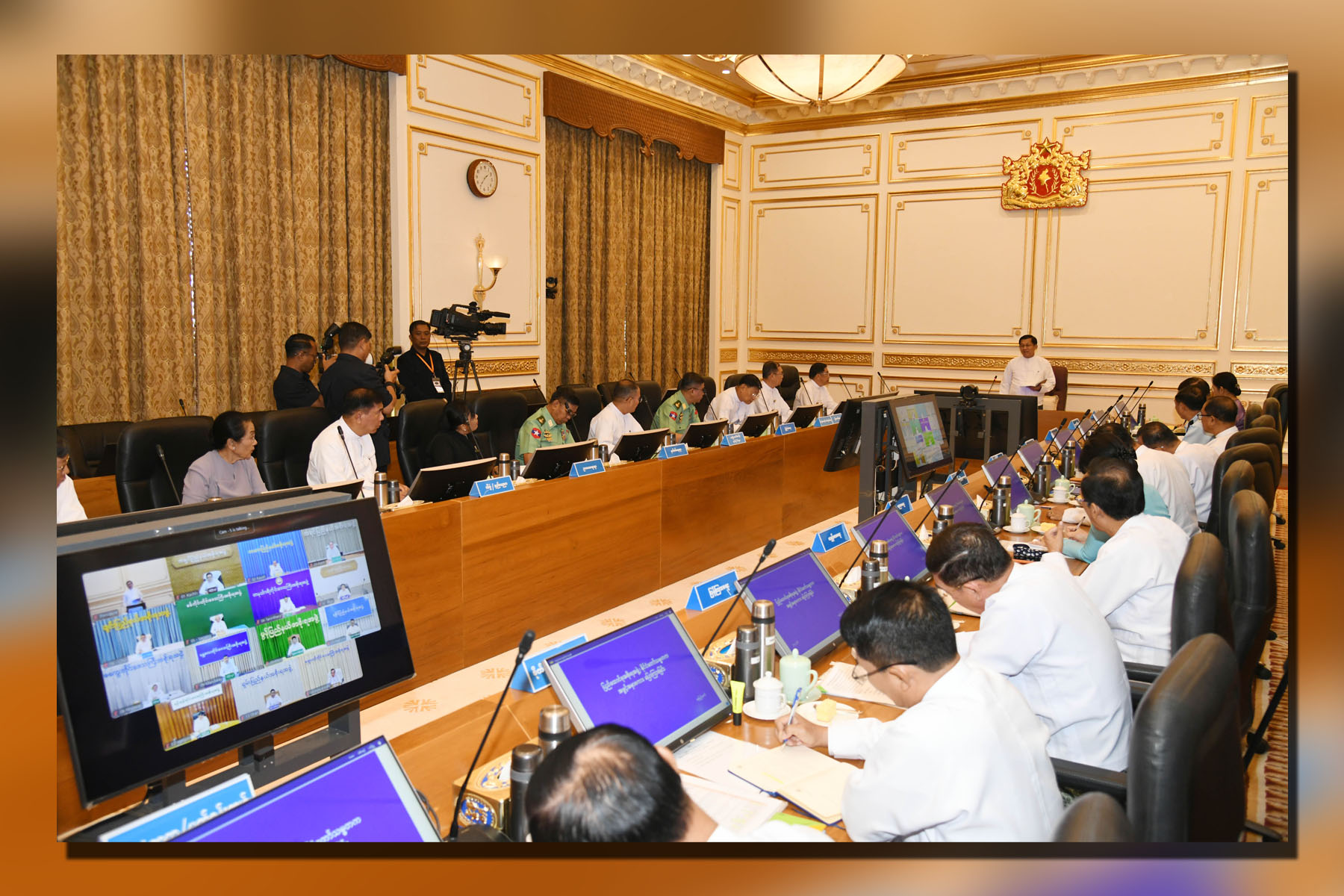
President U Min Aung Hlaing underscored the 100-day programme of the government at the meeting of the Union government of the Republic of the Union of Myanmar at its meeting hall of the Presidential Palace Reception Hall in Nay Pyi Taw yesterday afternoon.
Speaking on the occasion, the President recounted that he had replied to the media at the reaffirmation ceremony, saying that he will prioritize peace and stability of the State and development measures. Moreover, he had urged the people to work in concert and unity.
In order to develop the country’s education sector, the President stated that the government has transformed the system into a compulsory education system up to KG+9. In the 2026-2027 financial year, 6.92 per cent of the State budget has been allocated to the Ministry of Education, and when education-related expenditures of other ministries are included, a total of 9.22 per cent of the State budget will be spent on the education sector. In the upcoming financial year, the budget allocation for the education sector will be increased to no less than 10 per cent of the national budget, and within the following year, it will be further raised to 15 per cent. Over the five-year term of the government, spending on education will be increased to up to 20 per cent of the national budget.
The President noted that it is necessary to improve the mindset of the people by enhancing the education sector.
According to the press release, he highlighted that the poverty rate of Myanmar is higher among the regional countries. In this regard, rural people are suffering the impacts of poverty. As such, only when the government strives to improve the economy of the rural people will they have increased income and enjoy an improvement of socioeconomic lives. Consequently, the poverty rate will decline. The government has planned to establish more industrial, agriculture and livestock basic education high schools across the nation.
The President stressed that efforts must be made to generate hydropower from renewable energy and solar power in order to develop the nation. Micro, small and medium enterprises are playing a key role in boosting the production of goods. The government issues loans to MSME businesses for their development by easing necessary restrictions. Likewise, the manufacturing of products must be carried out through the cooperative system. Now, in a digital technological era, relevant ministries need to strive for improvement of technologies in the international landscape by keeping abreast of other countries in information technology.
Regarding peace, the President noted that PDF terrorist groups have been committing various destructive acts in some areas of the country. Most of these actions include collecting extortion money and illegal checkpoint fees, as well as unlawfully extracting forest resources and natural resources both above and below ground for their own benefit. At present, the democratically elected government has already assumed state responsibilities. So, efforts will be made to invite these PDF terrorist groups to return to the legal framework.
Concerning the 100-day programme of the government, the President said: “Since it is 100 days, today would be the 20th of April, so it is easy to remember. We can set 31 July as the 100th day. I would like to briefly mention the 100 days, setting 31 July as the final date. Regarding the PDF issue mentioned earlier, we have already stated that they are also invited to participate in dialogue and peace efforts for peace and reconciliation. At present, many have already returned to the legal fold. In areas of the Central Command and Southern Command, there have been many who have returned to the legal fold. In the Central Command area in particular, the number is quite large – hundreds have already come in. Some have made requests to join. We welcome them. About the PDFs, we are inviting them to come forward for peace within these 100 days.
“I would like to emphasize two portions for the Ethnic Armed Organization (EAO). For the first one, some EAOs have signed the Nationwide Ceasefire Agreement (NCA), and others have not yet signed it. So, we invite both types of EAOs, including the NCA non-signatories. Before 31 July, we invite the NCA non-signatories to hold talks. Tomorrow, we will release announcements. Now, I talk about it in advance. Another point: some NCA signatories did not hold talks within five years. For example, these are KNU, CNF and ABSDF. So, I invite them. We invite these EAOs to hold talks. Moreover, some NCA signatories have inked agreements. For example, they agreed on 43 points. They have signed the NCA and agreed to the Union Accords. We will submit these in sections at the upcoming Pyidaungsu Hluttaw.
“For groups that have not yet engaged in dialogue and negotiation, we also invite them to come and participate in discussions by the final deadline of 31 July. We also desire peace. If there is no stability and peace in the country, nothing can be done in terms of development. Only when peace is achieved and stability exists can development activities be carried out. If construction work is carried out ahead, but destructive activities come in from behind. Therefore, in terms of peace, if unrealistic demands are being made and it is claimed that this is for the sustainability of one’s own organization that would be a mistake. From our side as well, the State will need to take necessary and appropriate actions where required. Therefore, EAOs, including both NCA signatories and non-signatories, are invited to participate in the peace process. Meetings and discussions will be held before 31 July. Similarly, in regard to the PDFs, they are also invited to enter the legal framework during this period. There are no valid political justifications for what is happening. As mentioned earlier, they are simply being exploited. Therefore, they are urged to avoid being used or manipulated.”
The President stated that the Ministry of Finance and Revenue of the government will increase the disbursement of loans to farmers under the loan disbursement plan within 100 days. In this regard, the ministry will issue K300,000 for paddy, wheat and long staple cotton, K250,000 for the other 18 kinds of crops and K150,000 for niger, canola and jute. Moreover, the loans will be set at less than K300 million and more than K300 million for agricultural machinery.
The President expressed his 100- day plan, stating that the government will finish the upgrade of Anisakhan Airfield. Myanma Port Authority will prioritize the construction of warehouses. Moreover, railways will be upgraded as much as possible, prioritizing the Yangon-Mandalay, Yangon-Mawlamyine and Yangon-Pyay sections. Roads and tracks will be repaired on the Myitkyina-Mogaung-Mohnyin railway. In addition, locomotives, carriages and factories will be improved. In the communication sector, 27 new mobile stations will be extended within 100 days. Of them, nine mobile stations will be upgraded to 4G LTE facilities.
He added that the Ministry of Cooperatives and Rural Development will carry out rural water supply for consumption and agricultural activities through the solar-powered water pumping system. The Ministry of Education will establish the pilot universities to enhance the research capacity. Primarily, Naypyitaw State Academy, Yangon University and Mandalay University will be set as the research and project pilot universities. Starting from the 2026-27 academic year, the middle school education will be facilitated with industrial, agriculture and livestock subjects. Civic ethics and morality subjects will be taught at basic education schools. To emerge the schools with five strengths, the Ministry of Sports, the Ministry of Youth Affairs, and the Myanmar Football Federation will conduct the smart school and football for school programmes at the schools in Yangon, Mandalay, Ayeyawady and Bago regions and Shan State as pilot projects.
The President underlined that the Ministry of Health will appoint deputy health officers in 50 regions and states, districts and townships in order to enhance the healthcare activities. Medical wards at the heart treatment units at Nay Pyi Taw, Yangon and Mandalay will conduct the medical treatment, assessing the heart diseases for 100,000 patients in cooperation with China. Moreover, nursing schools in regions and states will be upgraded to nursing institutes.
Union ministers and the Kachin State government reported on matters related to signing the MoU and the MoA, invitation to tender, issuance of the citizenship scrutiny cards for children above 10 years, collection of data for EID and knowledge-sharing of the Ayeyawady Myitson project.
In his response, the President said that inviting tenders must meet the qualification and standards without wasting time. He urged all to prioritize development undertakings in regions and states which face lesser improvement. The President pledged that development projects in education, health and transport will be implemented in addition to the rehabilitation of government buildings, roads, bridges and communication infrastructures damaged by the natural disasters. Moreover, the earthquake-affected staff housing will be repaired soon. He urged all to efficiently spend the State budget without waste.
Also, present at the meeting were Vice-Presidents U Nyo Saw and Nan Ni Ni Aye, Union ministers and the Nay Pyi Taw Council Chairman, together with chief ministers of regions and states through videoconferencing. – MNA/TTA