
By Maung Maung Aye
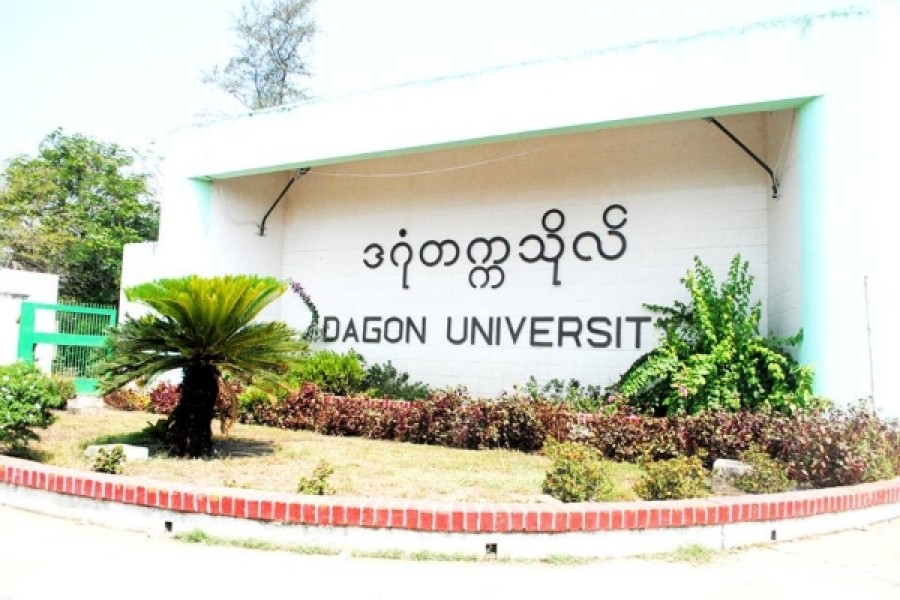
Some places fade from memory over time. Others stay in the heart forever. For me, Dagon University is one of those special places. Recently, I had the chance to visit it again. As our car carried me through the western arched gateway, my old memories came back to me.
Our car passed through the arched-way gate of Dagon University. Not far from the entrance on the left side, I espied the buildings (Chummeries)where single lady-teachers once lodged. On the right, wide fields stretched out with one herd of grazing cows. Some tiny houses were tucked away in the midst of the forested area. Everything looked smaller than I remembered. The university had not changed. Perhaps, I had simply grown older.
We drove on. At a junction just before the roundabout, I saw a road lined with Padauk trees. Later, I learned it is called Padauk Road, named after those very trees and the Padauk Hostel at its beginning. During the Thingyan Water Festival or the early periods of the Rainy Season, the Padauk trees burst into full bloom, a golden spectacle that delighted every viewer. Even now, without the flowers, the road whispered of those joyful seasons.
My thoughts were interrupted by cheers from a football stadium opposite Padauk Hostel. I, from the car window, caught sight of young footballers vying for a trophy. Their energy and excitement reminded me of my own youth. For a moment, I left as if I had returned to my university studenthood.
Soon, our car reached the Dagon University Roundabout, where Tawwin Road meets Bo Hmu Ba Htoo Road. There, a bevy of university girls were having their photos taken among colourful flowers. Shrubs of flowering plants surrounded the junction; butterflies hovered above them, drawing nectar. The atmosphere was pleasant and joyful.
As I watched those girls laugh and pose, my mind drifted back to the campus I once knew. In those days, Dagon University stood among large farmlands. Vast stretches of watercress were studded with clumps of plantain. Endless paddy fields stretched to the horizon. In the rainy season, nature turned the campus into a beautiful painting. Fresh green grass spread everywhere. Rainwater gathered in ponds and puddles, reflecting the changing sky.
Ducks swam peacefully. Cattle and buffaloes walked slowly across the fields. After rain, flocks of white birds appeared suddenly, flying gracefully under dark clouds. A gentle breeze carried the smell of wet grass and soil. It was a peaceful place that calmed the mind and spirit.
One of the most beautiful sights was the blooming Seinpan and Ngu flowers after rainfall. Their petals held sparkling raindrops like tiny jewels. Walking under those trees on wet roads, I often felt magical. It was a peaceful world far away from everyday worries.
Now, returning in a different season, I saw that the campus had not lost its charm. The grazing cows are still there. The Padauk trees still stand proudly. And the laughter of students still fills the campus.
Our car turned around the roundabout and proceeded along Tawwin Road towards the convocation building. I espied it ahead — a stately structure built to confer degrees personally upon students. Inside the convocation hall, statues of former rectors such as Sayagyi U Kaung Nyunt stand in honour of their contributions to the university. Today, in addition to graduation ceremonies, the building hosts celebrations, feasts, academic talks, and more — all held with pomp and ceremony. Standing there, I remembered my own graduation day. I remembered the excitement, the pride, and the sadness of leaving university life behind. These memories returned to me with surprising clarity.
I saw the Science Buildings along Science Road and the Arts Buildings along Arts Road. I also saw the Science Canteen on Science Road and the Arts Canteen on Arts Road. Both were packed with customers because it was a break time. The sight brought back a flood of ordinary moments: Resonant voices of teachers wafting from lecture rooms, the sounds of students’ shuffling steps along the corridor after the class, the crowded canteens filled with cheerful conversations, the excitement of meeting friends every morning, the quiet walks across campus at sunset.
The university estate held many academic buildings, hostels, recreational centres, theatres, and more. Packs of students walked about along the roads — just as we once did. I watched them pass and thought of my own friends from the English specialization, who shared the same dreams and hopes. Together, we went to lectures, prepared for exams, shared ideas, and encouraged each other through good times and bad.
The university library was our favourite place. During exam time, its quiet halls were filled with students reading books and notes. But beneath the silence, the library held countless conversations, hopes, and dreams. There, we learned not only from textbooks but from each other. Those days taught us hard work, teamwork, and never giving up. More importantly, they built friendships that still mean everything to us.
University life was not only about studying. We pilgrimage to the Kyaiktiyo Pagoda once a year. We enjoyed the cool mountain air, the sight of the Golden Rock shining against the sky and shared happy moments. At the pagoda, we prayed for academic success, good health, and a bright future. Standing together in that sacred place, we felt hope and purpose.
We also took part in religious and social activities. During the Buddhist rains-retreat period, we volunteered at the University Dhammayon, helped with donation ceremonies, joined blood donation campaigns, and performed other charitable acts. These experiences taught us kindness, generosity and compassion.
As the years passed, university life slowly changed us. We entered as uncertain teenagers and left as confident young adults. Graduation marked the beginning of a new chapter in our lives.
Even today, whenever I think of Dagon University, I can still see the rain-soaked fields shining under grey skies. I can still hear the happy voices of friends gathering after class. I can still feel the young hope that once filled our hearts.
As the years pass, I have come to realize that the value of university life lies not only in academic achievements. It also lies in the simple moments we shared every day.
Nostalgia transforms simple experiences into precious treasures. A familiar song, the scent of rain on earth, the sight of a university campus — any of these can suddenly transport me back to those youthful days.
There is a unique beauty in university nostalgia because it reminds us of a period when life was filled with dreams and possibilities. We were young, hopeful, and eager to build the future. Although time has carried us in different directions, the friendships we formed, the lessons we learned, and the experiences we shared continue to live within us.
All too soon, our car was prepared to leave. I took one last look at the roundabout, the Padauk trees, the convocation building, and the students still laughing under the midday sun. I realized that a visit to Dagon University is never just a visit. It is a meeting between who I am now and who I once was.
Time has taken us far away from those university days. But their beauty has not faded. Dagon University was more than a place to study. It was a place of friendship, growth, and discovery. Its green fields, blooming flowers, and dear friends created a collection of memories that still make my life brighter.
Looking back, I understand that the greatest gift of university life was not found in great achievements. It was found in the simple moments shared with friends during the most beautiful years of youth. They remain like golden rays of sunlight, shining through the years and reminding me where my journey began.