
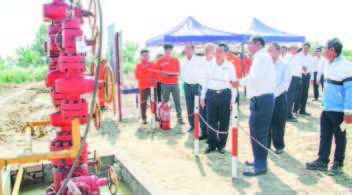
Union Minister for Energy U Ko Ko Lwin visited the Aphyauk Natural Gas Field under the Myanma Oil and Gas Enterprise (MOGE) on 20 Januray 2024 and observed oil fields Nos 50 and 54, where thin layers of sand were studied and researched to enhance natural gas production, ultimately leading to a genuine increase in production.
The Union minister-led team initially visited oil field No 60 of the Aphyauk Natural Gas Field, where oil exploration is ongoing. Officials explained the working processes of the Aphyauk Natural Gas Field.
The Union minister remarked that reviving the operations of old natural gas fields after conducting proper research and development is considered a positive achievement for the country’s oil and gas exploration efforts. He also encouraged exploration in other oil fields to achieve results similar to those of the Aphyauk Natural Gas Field. The Union minister, mentioned that oil field No 60, currently undergoing exploration, is also expected to yield positive results. Relevant departments are making necessary arrangements to increase productivity in oil and gas fields with reduced output.
There is a need to study the required skills to leverage advanced technologies, and efforts are underway to integrate recent research and AI technologies for effective utilization in oil and natural gas exploration and production. This approach aims to calculate the trapped amounts of oil and natural gas in sedimentary rocks and thin layers of sand, leading to increased productivity.
Subsequently, the managing director of the MOGE cordially presented record photos honouring the renewal and increased productivity of oil fields Nos 50 and 54 of the Aphyauk Natural Gas Field to the Union minister.
Discovered in 1991, the Aphyauk Natural Gas Field saw a decline in production, almost ceasing since 2019. Efforts are now underway to revitalize production. The natural gas produced by the Aphyauk Natural Gas Field is supplied to urea fertilizer factories, liquefied petroleum gas plants, and vehicles using Compressed Natural Gas (CNG).
While the required natural gas for CNG vehicles was previously combined with high-valued natural gases from Yadana, Zawtika, and Shwe offshore sites due to decreasing production from onshore sites, the increased productivity from the Aphyauk Natural Gas Field allows for a reduction in mixing with offshore gases.
Increasing natural gas production from the thin layers of sand in the Aphyauk Natural Gas Field is considered a significant milestone for the MOGE. — MNA/TMT